Definite integrals Evaluate the following integrals using the Fundamental Theorem of Calculus
∫π/₄^³π/⁴ (cot² 𝓍 + 1) d𝓍
Verified step by step guidance
1
Step 1: Recognize that the integral ∫π/₄^³π/⁴ (cot² 𝓍 + 1) d𝓍 can be simplified using trigonometric identities. Recall that cot²(𝓍) + 1 = csc²(𝓍). This simplifies the integral to ∫π/₄^³π/⁴ csc²(𝓍) d𝓍.
Step 2: Identify the antiderivative of csc²(𝓍). The antiderivative of csc²(𝓍) is -cot(𝓍). Using this, rewrite the integral as [-cot(𝓍)] evaluated from π/4 to 3π/4.
Step 3: Apply the Fundamental Theorem of Calculus. Substitute the upper limit (𝓍 = 3π/4) and the lower limit (𝓍 = π/4) into the antiderivative -cot(𝓍). This gives -cot(3π/4) - (-cot(π/4)).
Step 4: Simplify the expression. Use the unit circle or trigonometric properties to evaluate cot(3π/4) and cot(π/4). Recall that cot(π/4) = 1 and cot(3π/4) = -1.
Step 5: Combine the results from the previous step to find the value of the definite integral. This involves subtracting the evaluated terms from Step 4.
Verified video answer for a similar problem:
This video solution was recommended by our tutors as helpful for the problem above
Video duration:
2m
Play a video:
0 Comments
Key Concepts
Here are the essential concepts you must grasp in order to answer the question correctly.
Fundamental Theorem of Calculus
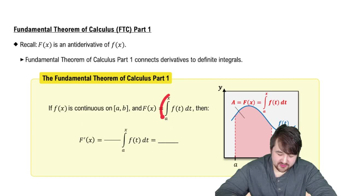
The Fundamental Theorem of Calculus links the concept of differentiation with integration, stating that if a function is continuous on an interval [a, b], then the integral of its derivative over that interval equals the difference in the values of the function at the endpoints. This theorem allows us to evaluate definite integrals by finding an antiderivative of the integrand.
A definite integral represents the signed area under a curve defined by a function over a specific interval [a, b]. It is calculated using the limits of integration, which specify the interval, and provides a numerical value that reflects the accumulation of quantities, such as area, over that interval.
Trigonometric identities are equations involving trigonometric functions that hold true for all values of the variables involved. In the context of the given integral, recognizing that cot² x + 1 equals csc² x can simplify the integration process, making it easier to evaluate the integral by transforming it into a more manageable form.