Ch. 1 - Functions
Hass - Thomas' Calculus 15th Edition
Hass15th EditionThomas' CalculusISBN: 9780137616077Not the one you use?Change textbook
Chapter 1, Problem 1.19

In Exercises 19–32, find the (a) domain and (b) range.


𝔂 = |x| - 2

Verified step by step guidance
1
Step 1: Identify the function type. The given function is 𝑦 = |𝑥| - 2, which is an absolute value function. Absolute value functions are defined for all real numbers.
Step 2: Determine the domain of the function. Since the absolute value function is defined for all real numbers, the domain of 𝑦 = |𝑥| - 2 is all real numbers, which can be expressed as (-∞, ∞).
Step 3: Analyze the transformation of the function. The function 𝑦 = |𝑥| - 2 is a vertical shift of the basic absolute value function 𝑦 = |𝑥|. The graph of 𝑦 = |𝑥| is shifted 2 units downward.
Step 4: Determine the range of the function. The basic absolute value function 𝑦 = |𝑥| has a range of [0, ∞). After shifting the graph 2 units downward, the range of 𝑦 = |𝑥| - 2 becomes [-2, ∞).
Step 5: Summarize the domain and range. The domain of the function 𝑦 = |𝑥| - 2 is all real numbers (-∞, ∞), and the range is [-2, ∞).

Verified video answer for a similar problem:

This video solution was recommended by our tutors as helpful for the problem above.
Video duration:
3m
Was this helpful?

Key Concepts

Here are the essential concepts you must grasp in order to answer the question correctly.

Domain

The domain of a function refers to the set of all possible input values (x-values) for which the function is defined. For the function y = |x| - 2, the absolute value function |x| is defined for all real numbers, meaning the domain is all real numbers, or (-∞, ∞). Understanding the domain is crucial for determining the valid inputs for the function.
Recommended video:
5:10
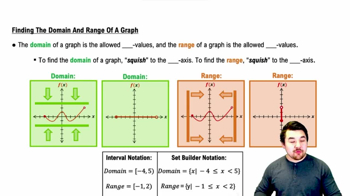
Finding the Domain and Range of a Graph

Range

The range of a function is the set of all possible output values (y-values) that the function can produce. In the case of y = |x| - 2, the minimum value occurs when |x| is zero, resulting in y = -2. As x increases or decreases, y increases without bound. Therefore, the range is [-2, ∞), indicating that y can take any value greater than or equal to -2.
Recommended video:
5:10
Finding the Domain and Range of a Graph

Absolute Value Function

The absolute value function, denoted as |x|, outputs the non-negative value of x regardless of its sign. This means |x| is always zero or positive. In the function y = |x| - 2, the absolute value affects the shape of the graph, creating a V-like structure that opens upwards, shifted down by 2 units. Understanding this function is essential for analyzing the overall behavior of the given equation.
Recommended video:
06:37
Average Value of a Function