
Textbook Question
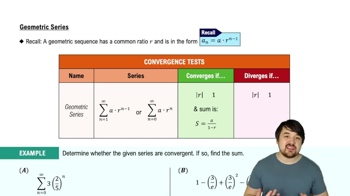
18–20. Evaluating geometric series two ways Evaluate each geometric series two ways.
a. Find the nth partial sum Sₙ of the series and evaluate lim (as n → ∞) Sₙ.
∑ (k = 0 to ∞) (–2/7)ᵏ
60
views

 Verified step by step guidance
 06:00
06:00
 05:00
05:00 5:57
5:5718–20. Evaluating geometric series two ways Evaluate each geometric series two ways.
a. Find the nth partial sum Sₙ of the series and evaluate lim (as n → ∞) Sₙ.
∑ (k = 0 to ∞) (–2/7)ᵏ
41–44. {Use of Tech} Remainders and estimates Consider the following convergent series.
a. Find an upper bound for the remainder in terms of n.
43. ∑ (k = 1 to ∞) 1 / 3ᵏ
57–60. Heights of bouncing balls A ball is thrown upward to a height of hₒ meters. After each bounce, the ball rebounds to a fraction r of its previous height. Let hₙ be the height after the nth bounce. Consider the following values of hₒ and r.
a. Find the first four terms of the sequence of heights {hₙ}.
h₀ = 30,r = 0.25
67–70. Formulas for sequences of partial sums Consider the following infinite series.
a.Find the first four partial sums S₁, S₂, S₃, S₄ of the series.
∑⁽∞⁾ₖ₌₁2⁄[(2k − 1)(2k + 1)]
87. Explain why or why not
Determine whether the following statements are true and give an explanation or counterexample.
b. If ∑ (k = 1 to ∞) aₖ diverges, then ∑ (k = 10 to ∞) aₖ diverges.
{Use of Tech} Periodic dosing
Many people take aspirin on a regular basis as a preventive measure for heart disease. Suppose a person takes 80 mg of aspirin every 24 hours. Assume aspirin has a half-life of 24 hours; that is, every 24 hours, half of the drug in the blood is eliminated.
a.Find a recurrence relation for the sequence {dₙ} that gives the amount of drug in the blood after the nᵗʰ dose, where d₁ = 80.