23-64. Integration Evaluate the following integrals. 38. ∫₀⁵ 2/(x² - 4x - 32) dx
Verified step by step guidance
1
Start by examining the integrand: \( \frac{2}{x^{2} - 4x - 32} \). The first step is to factor the quadratic expression in the denominator to simplify the integral.
Rewrite the quadratic \( x^{2} - 4x - 32 \) by factoring it. Find two numbers that multiply to \(-32\) and add to \(-4\). This will allow you to express the denominator as \( (x - a)(x - b) \).
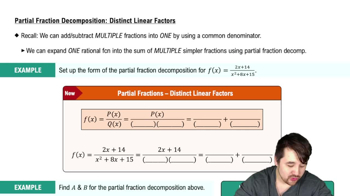
Once factored, express the integrand as a sum of partial fractions: \( \frac{2}{(x - a)(x - b)} = \frac{A}{x - a} + \frac{B}{x - b} \). Set up an equation to solve for constants \( A \) and \( B \).
Solve for \( A \) and \( B \) by multiplying both sides by the denominator \( (x - a)(x - b) \) and equating coefficients or substituting convenient values of \( x \).
After finding \( A \) and \( B \), rewrite the integral as \( \int_{0}^{5} \left( \frac{A}{x - a} + \frac{B}{x - b} \right) dx \). Then integrate each term separately using the natural logarithm: \( \int \frac{1}{x - c} dx = \ln|x - c| + C \).
Verified video answer for a similar problem:
This video solution was recommended by our tutors as helpful for the problem above
Video duration:
6m
Play a video:
0 Comments
Key Concepts
Here are the essential concepts you must grasp in order to answer the question correctly.
Definite Integrals
A definite integral calculates the net area under a curve between two limits, here from 0 to 5. It involves evaluating the antiderivative at the upper and lower bounds and subtracting these values to find the integral's value over the interval.
Partial fraction decomposition breaks a rational function into simpler fractions that are easier to integrate. For integrals involving quadratic denominators, factoring the denominator and expressing the integrand as a sum of simpler fractions is essential.
Partial Fraction Decomposition: Distinct Linear Factors
Integration of Rational Functions
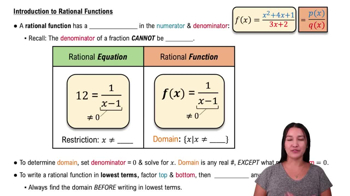
Integrating rational functions often requires algebraic manipulation such as factoring and partial fractions. Recognizing forms like ∫1/(x - a) dx = ln|x - a| + C helps in solving integrals involving rational expressions.