Ch. 10 - Sequences and Infinite Series
Briggs - Calculus: Early Transcendentals 3rd Edition
Briggs3rd EditionCalculus: Early TranscendentalsISBN: 9780136847243Not the one you use?Change textbook
Chapter 10, Problem 10.8.15

11–86. Applying convergence tests Determine whether the following series converge. Justify your answers.
∑ (from k = 1 to ∞) (−7)ᵏ / k!

Verified step by step guidance
1
Identify the given series: \( \sum_{k=1}^{\infty} \frac{(-7)^k}{k!} \). This is an infinite series with terms involving factorials in the denominator.
Recall that factorials grow very rapidly, which often suggests the series might converge. To confirm, consider applying the Ratio Test, which is useful for series with factorials and exponentials.
Set up the Ratio Test by examining the limit \( L = \lim_{k \to \infty} \left| \frac{a_{k+1}}{a_k} \right| \), where \( a_k = \frac{(-7)^k}{k!} \). Substitute to get \( L = \lim_{k \to \infty} \left| \frac{(-7)^{k+1} / (k+1)!}{(-7)^k / k!} \right| \).
Simplify the expression inside the limit: \( L = \lim_{k \to \infty} \left| \frac{-7}{k+1} \right| = \lim_{k \to \infty} \frac{7}{k+1} \). Since \( \frac{7}{k+1} \to 0 \) as \( k \to \infty \), the limit \( L = 0 \).
Interpret the Ratio Test result: since \( L < 1 \), the series \( \sum_{k=1}^{\infty} \frac{(-7)^k}{k!} \) converges absolutely. Therefore, the series converges.

Verified video answer for a similar problem:

This video solution was recommended by our tutors as helpful for the problem above.
Video duration:
3m
Was this helpful?

Key Concepts

Here are the essential concepts you must grasp in order to answer the question correctly.

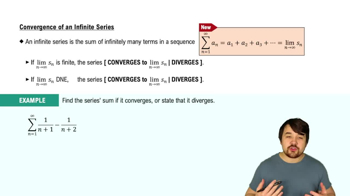
Convergence of Infinite Series

An infinite series converges if the sequence of its partial sums approaches a finite limit. Understanding convergence is essential to determine whether the sum of infinitely many terms results in a finite value or diverges to infinity or oscillates.
Recommended video:
06:52
Convergence of an Infinite Series

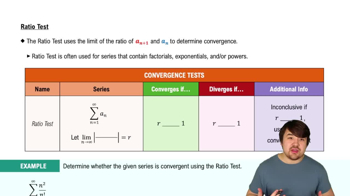
Ratio Test

The ratio test evaluates the limit of the absolute value of the ratio of consecutive terms. If this limit is less than one, the series converges absolutely; if greater than one, it diverges. This test is particularly useful for series involving factorials or exponential terms.
Recommended video:
05:35
Ratio Test

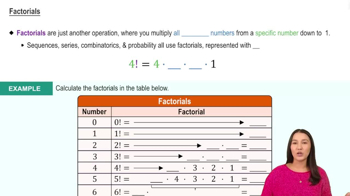
Factorials and Their Growth

Factorials (n!) grow very rapidly compared to exponential or polynomial terms. Recognizing the dominance of factorial growth helps in applying convergence tests, as terms with factorials in the denominator often lead to convergence due to rapid term size reduction.
Recommended video:
5:22
Factorials