
Each figure in Exercises 45–50 shows the graph of a function over a closed interval D. At what domain points does the function appear to be
a. differentiable?
Give reasons for your answers.
Verified step by step guidance
1
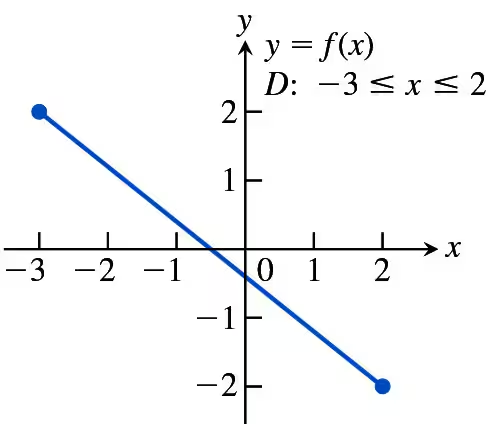
Examine the graph of the function over the interval D: [-3, 2]. The function is represented by a straight line, which suggests it is a linear function.
Recall that a function is differentiable at a point if it is continuous at that point and has a defined derivative there. Linear functions are differentiable everywhere on their domain.
Check the endpoints of the interval, x = -3 and x = 2. At x = -3, the function is continuous and the derivative exists because the line extends smoothly from this point. At x = 2, the function is also continuous and the derivative exists as the line ends smoothly.
Since the function is a straight line, it is differentiable at every point in the interval D: [-3, 2]. There are no corners, cusps, or vertical tangents that would make the function non-differentiable at any point.
Conclude that the function is differentiable at all points in the domain D: [-3, 2] because it is a linear function, which is inherently differentiable across its entire domain.
Verified video answer for a similar problem:
This video solution was recommended by our tutors as helpful for the problem above
Video duration:
1m
Play a video:
0 Comments
Key Concepts
Here are the essential concepts you must grasp in order to answer the question correctly.
Differentiability
A function is differentiable at a point if it has a defined derivative at that point, meaning the function's graph has a tangent line that is well-defined. This requires the function to be continuous at that point and for the left-hand and right-hand derivatives to be equal. Points where the graph has sharp corners, vertical tangents, or discontinuities indicate non-differentiability.
A function is continuous at a point if the limit of the function as it approaches that point equals the function's value at that point. This means there are no breaks, jumps, or holes in the graph at that point. For a function to be continuous over an interval, it must be continuous at every point within that interval.
A closed interval, denoted as [a, b], includes all numbers between a and b, as well as the endpoints a and b themselves. In the context of calculus, analyzing functions over closed intervals is important for determining properties like continuity and differentiability at the endpoints, which can behave differently than points within the interval.