7–58. Improper integrals Evaluate the following integrals or state that they diverge. 25. ∫ (from -∞ to ∞) e³ˣ/(1 + e⁶ˣ) dx
Verified step by step guidance
1
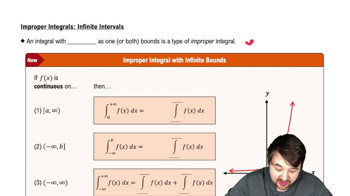
First, recognize that the integral is an improper integral with limits from \(-\infty\) to \(\infty\), so we need to consider the behavior of the integrand as \(x \to -\infty\) and \(x \to \infty\).
Rewrite the integrand to see if it can be simplified. The integral is \(\int_{-\infty}^{\infty} \frac{e^{3x}}{1 + e^{6x}} \, dx\). Notice that \(e^{6x} = (e^{3x})^2\), so the denominator is \$1 + (e^{3x})^2$.
Make the substitution \(t = e^{3x}\). Then, \(dt = 3 e^{3x} dx = 3 t dx\), which implies \(dx = \frac{dt}{3t}\). Also, as \(x \to -\infty\), \(t \to 0\), and as \(x \to \infty\), \(t \to \infty\).
Rewrite the integral in terms of \(t\): \(\int_{0}^{\infty} \frac{t}{1 + t^2} \cdot \frac{1}{3t} dt = \frac{1}{3} \int_{0}^{\infty} \frac{1}{1 + t^2} dt\). Notice how the \(t\) in numerator and denominator cancel out.
Recognize that \(\int \frac{1}{1 + t^2} dt\) is the standard integral for \(\arctan t\). So, the integral becomes \(\frac{1}{3} [\arctan t]_{0}^{\infty}\). Evaluate this expression to determine the value of the integral or conclude if it converges.
Verified video answer for a similar problem:
This video solution was recommended by our tutors as helpful for the problem above
Video duration:
13m
Play a video:
0 Comments
Key Concepts
Here are the essential concepts you must grasp in order to answer the question correctly.
Improper Integrals
Improper integrals involve integration over infinite intervals or integrands with infinite discontinuities. To evaluate them, limits are used to approach the infinite bounds or points of discontinuity, determining if the integral converges to a finite value or diverges.
The substitution method simplifies integrals by changing variables to transform the integral into a more manageable form. This technique is especially useful when the integrand contains composite functions, allowing easier evaluation or recognition of standard integral forms.
Understanding the growth and decay properties of exponential functions is crucial in evaluating integrals with infinite limits. Exponentials like e^{3x} and e^{6x} can dominate the integrand's behavior at ±∞, affecting convergence and simplifying the integral through algebraic manipulation.