Ch. 5 - Integration
Briggs - Calculus: Early Transcendentals 3rd Edition
Briggs3rd EditionCalculus: Early TranscendentalsISBN: 9780136847243Not the one you use?Change textbook
Chapter 5, Problem 5.R.102a

Function defined by an integral Let H (๐“) = โˆซโ‚€หฃ โˆš(4 โ€• tยฒ) dt, for โ€• 2 โ‰ค ๐“ โ‰ค 2.
(a) Evaluate H (0) .

Verified step by step guidance
1
Step 1: Understand the problem. The function H(๐“) is defined as an integral from 0 to ๐“ of โˆš(4 โˆ’ tยฒ) dt. For part (a), we are tasked with evaluating H(0), which means substituting ๐“ = 0 into the integral.
Step 2: Substitute ๐“ = 0 into the integral definition. This gives H(0) = โˆซโ‚€โฐ โˆš(4 โˆ’ tยฒ) dt.
Step 3: Recognize that the integral's limits are both 0. When the upper and lower limits of an integral are the same, the integral evaluates to 0. This is because there is no interval over which to integrate.
Step 4: Conclude that H(0) = 0 based on the property of definite integrals where the limits are equal.
Step 5: Reflect on the result. This step demonstrates the importance of understanding integral properties and how they simplify calculations in specific cases.

Verified video answer for a similar problem:

This video solution was recommended by our tutors as helpful for the problem above.
Video duration:
1m
Was this helpful?

Key Concepts

Here are the essential concepts you must grasp in order to answer the question correctly.

Definite Integral

A definite integral represents the signed area under a curve defined by a function over a specific interval. In this case, H(๐“) is defined as the integral of โˆš(4 - tยฒ) from 0 to ๐“. Evaluating a definite integral involves finding the antiderivative of the integrand and applying the Fundamental Theorem of Calculus.
Recommended video:
05:43
Definition of the Definite Integral

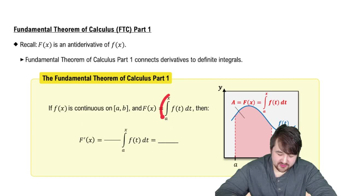
Fundamental Theorem of Calculus

The Fundamental Theorem of Calculus links differentiation and integration, stating that if F is an antiderivative of f on an interval [a, b], then the definite integral of f from a to b is F(b) - F(a). This theorem allows us to evaluate H(๐“) by finding an antiderivative of the integrand and substituting the limits of integration.
Recommended video:
06:11
Fundamental Theorem of Calculus Part 1

Geometric Interpretation of Integrals

Integrals can be interpreted geometrically as the area under a curve. For the function โˆš(4 - tยฒ), which describes a semicircle, the integral from 0 to ๐“ gives the area of the corresponding segment of the semicircle. Understanding this geometric interpretation aids in visualizing the result of the integral and its evaluation at specific points like H(0).
Recommended video:
Guided course
04:18
Geometric Sequences - Recursive Formula
Related Practice
Textbook Question

Limit definition of the definite integral Use the limit definition of the definite integral with right Riemann sums and a regular partition to evaluate the following definite integrals. Use the Fundamental Theorem of Calculus to check your answer. 


โˆซโ‚€โด (๐“ยณโ€•๐“) d๐“

96
views
Textbook Question

Integration by Riemann sums Consider the integral โˆซโ‚โด (3๐“โ€• 2) d๐“.


(b) Use summation notation to express the right Riemann sum in terms of a positive integer n .

100
views
Textbook Question

Velocity to displacement An object travels on the ๐“-axis with a velocity given by v(t) = 2t + 5, for 0 โ‰ค t โ‰ค 4.


(a) How far does the object travel, for 0 โ‰ค t โ‰ค 4 ?

81
views
Textbook Question

(b) Find the average value of ฦ’ shown in the figure on the interval [2,6] and then find the point(s) c in (2, 6) guaranteed to exist by the Mean Value Theorem for Integrals. 

47
views
Textbook Question

Use geometry and properties of integrals to evaluate the following definite integrals.

โˆซโ‚„โฐ (2๐“ + โˆš(16โ€•๐“ยฒ)) d๐“ . (Hint: Write the integral as sum of two integrals.)

114
views
Textbook Question

Explain why or why not Determine whether the following statements are true and give an explanation or counterexample. Assume ฦ’ and ฦ’' are continuous functions for all real numbers.

(d) If ฦ’ is continuous on [a,b] and โˆซโ‚แต‡ |ฦ’(๐“)| d๐“ = 0 , then ฦ’(๐“) = 0 on [a,b] .

64
views