Ch. 7 - Logarithmic, Exponential Functions, and Hyperbolic Functions
Briggs - Calculus: Early Transcendentals 3rd Edition
Briggs3rd EditionCalculus: Early TranscendentalsISBN: 9780136847243Not the one you use?Change textbook
Chapter 7, Problem 7.3.44

37–56. Integrals Evaluate each integral.
∫₀⁴ sech²√x / √x dx

Verified step by step guidance
1
Recognize that the integral is \( \int_0^4 \frac{\text{sech}^2(\sqrt{x})}{\sqrt{x}} \, dx \). The integrand involves \( \sqrt{x} \) both inside the hyperbolic secant squared function and in the denominator, suggesting a substitution involving \( \sqrt{x} \).
Make the substitution \( t = \sqrt{x} \), which implies \( x = t^2 \). Then, differentiate to find \( dx \) in terms of \( dt \): \( dx = 2t \, dt \).
Rewrite the integral in terms of \( t \): replace \( \sqrt{x} \) with \( t \), and \( dx \) with \( 2t \, dt \). The integral becomes \( \int_{t=0}^{t=2} \frac{\text{sech}^2(t)}{t} \cdot 2t \, dt \). Notice that the \( t \) in the denominator and numerator will cancel out.
Simplify the integral to \( \int_0^2 2 \text{sech}^2(t) \, dt \). This is now a standard integral involving \( \text{sech}^2(t) \), which is the derivative of \( \tanh(t) \).
Integrate \( 2 \text{sech}^2(t) \) with respect to \( t \) to get \( 2 \tanh(t) + C \), then apply the limits from 0 to 2 to express the definite integral.

Verified video answer for a similar problem:

This video solution was recommended by our tutors as helpful for the problem above.
Video duration:
2m
Was this helpful?

Key Concepts

Here are the essential concepts you must grasp in order to answer the question correctly.

Integration by Substitution

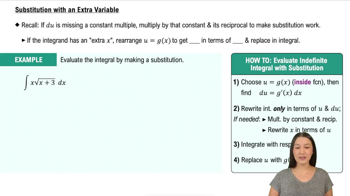
Integration by substitution is a technique used to simplify integrals by changing variables. It involves substituting a part of the integral with a new variable to transform the integral into a more manageable form. This method is especially useful when the integral contains composite functions, such as √x inside another function.
Recommended video:
04:27
Substitution With an Extra Variable

Hyperbolic Secant Function (sech)

The hyperbolic secant function, sech(x), is defined as 1/cosh(x), where cosh(x) is the hyperbolic cosine. Its square, sech²(x), often appears in integrals related to hyperbolic functions. Understanding its properties and derivatives helps in recognizing integrals that can be simplified using known formulas.
Recommended video:
6:22
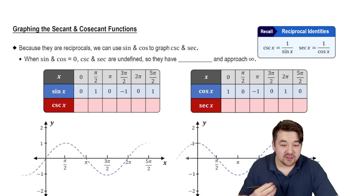
Graphs of Secant and Cosecant Functions

Definite Integrals and Limits of Integration

Definite integrals calculate the net area under a curve between two specific points, called limits of integration. Evaluating a definite integral involves finding the antiderivative and then applying the Fundamental Theorem of Calculus to compute the difference at the upper and lower limits.
Recommended video:
05:43
Definition of the Definite Integral