Ch. 8 - Integration Techniques
Briggs - Calculus: Early Transcendentals 3rd Edition
Briggs3rd EditionCalculus: Early TranscendentalsISBN: 9780136847243Not the one you use?Change textbook
Chapter 8, Problem 8.R.60

2–74. Integration techniques Use the methods introduced in Sections 8.1 through 8.5 to evaluate the following integrals.
60. ∫ x² coshx dx

Verified step by step guidance
1
Step 1: Recognize that the integral ∫ x² cosh(x) dx involves a product of a polynomial (x²) and a hyperbolic function (cosh(x)). This suggests that the method of integration by parts is appropriate. Recall the formula for integration by parts: ∫ u dv = uv - ∫ v du.
Step 2: Choose u and dv wisely. Let u = x² (the polynomial term, which simplifies upon differentiation) and dv = cosh(x) dx (the hyperbolic function, which is straightforward to integrate). Compute du = 2x dx and v = sinh(x), since the integral of cosh(x) is sinh(x).
Step 3: Apply the integration by parts formula: ∫ x² cosh(x) dx = u * v - ∫ v * du. Substitute u = x², v = sinh(x), and du = 2x dx into the formula to get: x² sinh(x) - ∫ 2x sinh(x) dx.
Step 4: Notice that the remaining integral ∫ 2x sinh(x) dx still involves a product of a polynomial and a hyperbolic function. Apply integration by parts again. Let u = 2x and dv = sinh(x) dx. Compute du = 2 dx and v = -cosh(x), since the integral of sinh(x) is -cosh(x).
Step 5: Substitute into the integration by parts formula for the second integral: ∫ 2x sinh(x) dx = u * v - ∫ v * du. This becomes 2x(-cosh(x)) - ∫ -cosh(x) * 2 dx. Simplify the expression and combine terms to complete the solution.

Verified video answer for a similar problem:

This video solution was recommended by our tutors as helpful for the problem above.
Video duration:
3m
Was this helpful?

Key Concepts

Here are the essential concepts you must grasp in order to answer the question correctly.

Integration Techniques

Integration techniques are methods used to find the integral of a function. Common techniques include substitution, integration by parts, and trigonometric identities. Understanding these methods is crucial for solving integrals that cannot be evaluated using basic antiderivatives.
Recommended video:
06:18
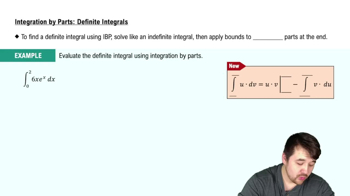
Integration by Parts for Definite Integrals

Hyperbolic Functions

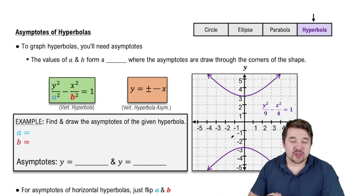
Hyperbolic functions, such as cosh(x), are analogs of trigonometric functions but are based on hyperbolas rather than circles. They are defined using exponential functions, with cosh(x) = (e^x + e^(-x))/2. Recognizing these functions and their properties is essential for evaluating integrals involving them.
Recommended video:
5:50
Asymptotes of Hyperbolas

Integration by Parts

Integration by parts is a technique derived from the product rule of differentiation. It is used to integrate products of functions and is expressed as ∫u dv = uv - ∫v du. This method is particularly useful when dealing with integrals that involve polynomial and hyperbolic functions, as in the given problem.
Recommended video:
06:18
Integration by Parts for Definite Integrals