
Textbook Question
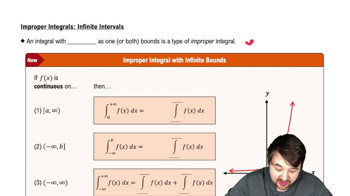
82-88. Improper integrals Evaluate the following integrals or show that the integral diverges.
84. ∫ (from 0 to π) sec²x dx*(Note: Potential improperness at x = π/2)*
34
views

 Verified step by step guidance
 11:11
11:11
 6:04
6:04 07:45
07:4582-88. Improper integrals Evaluate the following integrals or show that the integral diverges.
84. ∫ (from 0 to π) sec²x dx*(Note: Potential improperness at x = π/2)*
114. {Use of Tech} Arc length of the natural logarithm Consider the curve y = ln(x).
a. Find the length of the curve from x = 1 to x = a and call it L(a).
(Hint: The change of variables u = sqrt(x^2 + 1) allows evaluation by partial fractions.)
102–105. Volumes The region R is bounded by the curve y = ln(x) and the x-axis on the interval [1, e]. Find the volume of the solid generated when R is revolved in the following ways.
104. About the line y = 1
2–74. Integration techniques Use the methods introduced in Sections 8.1 through 8.5 to evaluate the following integrals.
35. ∫ x³/√(4x² + 16) dx
2–74. Integration techniques Use the methods introduced in Sections 8.1 through 8.5 to evaluate the following integrals.
65. ∫ (from 0 to 1) dy/((y + 1)(y² + 1))
2–74. Integration techniques Use the methods introduced in Sections 8.1 through 8.5 to evaluate the following integrals.
71. ∫ (2x² - 4x)/(x² - 4) dx