Ch. 6 - Applications of Definite Integrals
Hass - Thomas' Calculus 15th Edition
Hass15th EditionThomas' CalculusISBN: 9780137616077Not the one you use?Change textbook
Chapter 6, Problem 6.PE.41

Centers of Mass and Centroids

Find the center of mass of a thin, flat plate covering the region enclosed by the parabola 𝔂² = 𝓍 and the line 𝓍 = 2𝔂 if the density function is Ξ΄(𝔂) = 1 + 𝔂. (Use horizontal strips.)

Verified step by step guidance
1
First, identify the region bounded by the curves. The parabola is given by \(y^2 = x\), and the line is \(x = 2y\). To use horizontal strips, express \(x\) as a function of \(y\) for both curves. The parabola can be written as \(x = y^2\), and the line is already \(x = 2y\).
Determine the interval for \(y\) over which the region exists by finding the points of intersection between the two curves. Set \(y^2 = 2y\) and solve for \(y\) to find the limits of integration.
Set up the expressions for the area element \(dA\) using horizontal strips. Each strip has thickness \(dy\) and length given by the difference between the right and left boundaries in terms of \(x\): \(dA = (x_{right} - x_{left}) dy = (2y - y^2) dy\).
Write the density function as \(delta(y) = 1 + y\). Then, express the mass element \(dm\) as \(dm = delta(y) dA = (1 + y)(2y - y^2) dy\).
To find the center of mass coordinates \((\bar{x}, \bar{y})\), set up the integrals: \(M = \int dm = \int_{y_{min}}^{y_{max}} (1 + y)(2y - y^2) dy\) \(M_x = \int y \, dm = \int_{y_{min}}^{y_{max}} y (1 + y)(2y - y^2) dy\) \(M_y = \int x \, dm = \int_{y_{min}}^{y_{max}} \left( \frac{x_{right} + x_{left}}{2} \right) dm = \int_{y_{min}}^{y_{max}} \left( \frac{2y + y^2}{2} \right) (1 + y)(2y - y^2) dy\) Then compute \(\bar{x} = \frac{M_y}{M}\) and \(\bar{y} = \frac{M_x}{M}\).

Verified video answer for a similar problem:

This video solution was recommended by our tutors as helpful for the problem above.
Video duration:
9m
Was this helpful?

Key Concepts

Here are the essential concepts you must grasp in order to answer the question correctly.

Center of Mass and Centroids

The center of mass of a lamina is the point where it balances perfectly, calculated as the weighted average of coordinates using the density function. For a region with variable density, the coordinates (xΜ„, Θ³) are found by integrating moments about the axes divided by the total mass. This concept generalizes the centroid, which assumes uniform density.
Recommended video:
09:32
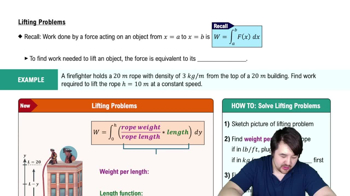
Lifting Problems

Setting up Integrals Using Horizontal Strips

Using horizontal strips means slicing the region parallel to the x-axis, integrating with respect to y. Each strip has a small thickness dy and length determined by the x-values on the boundary curves. This approach simplifies finding area elements and moments when the region is bounded by functions of y.
Recommended video:
08:01
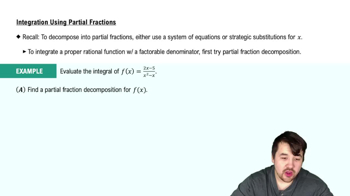
Integration Using Partial Fractions

Density Function Dependent on y

The density function δ(y) = 1 + y varies along the y-axis, affecting the mass distribution. When calculating mass and moments, the density must be included inside the integrals, weighting each strip accordingly. This leads to integrals of the form ∫δ(y)·(area element) dy, reflecting non-uniform density.
Recommended video:
06:30
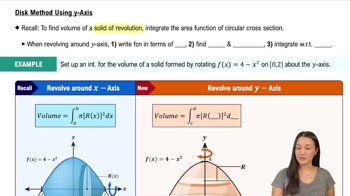
Disk Method Using y-Axis