Ch. 7 - Transcendental Functions
Hass - Thomas' Calculus 15th Edition
Hass15th EditionThomas' CalculusISBN: 9780137616077Not the one you use?Change textbook
Chapter 7, Problem 7.3.37

Evaluate the integrals in Exercises 33–54.
∫8e^(x+1) dx

Verified step by step guidance
1
Recognize that the integral is of the form \(\int 8 e^{x+1} \, dx\), where the integrand is an exponential function with a linear argument in the exponent.
Use the property of exponents to rewrite the integrand as \$8 e^{x} e^{1}$, or equivalently factor out the constant $e^{1}$ since it does not depend on $x$.
Rewrite the integral as \(8 e^{1} \int e^{x} \, dx\), separating the constant multiplier from the integral.
Recall the integral formula for the exponential function: \(\int e^{x} \, dx = e^{x} + C\), where \(C\) is the constant of integration.
Apply the integral formula and multiply back by the constants to express the antiderivative as \(8 e^{1} e^{x} + C\), which can be combined as \(8 e^{x+1} + C\).

Verified video answer for a similar problem:

This video solution was recommended by our tutors as helpful for the problem above.
Video duration:
1m

Key Concepts

Here are the essential concepts you must grasp in order to answer the question correctly.

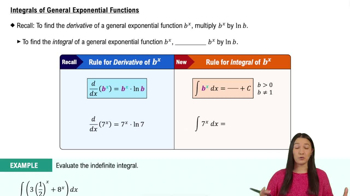
Integration of Exponential Functions

Integrating exponential functions involves reversing differentiation. For functions like e^(ax+b), the integral is (1/a)e^(ax+b) + C, where a and b are constants. Recognizing the inner function helps apply the correct formula.
Recommended video:
05:11
Integrals of General Exponential Functions

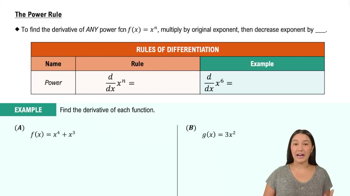
Constant Multiple Rule

The constant multiple rule states that a constant factor can be pulled out of the integral. For example, ∫k*f(x) dx = k*∫f(x) dx. This simplifies integration by isolating constants from variable expressions.
Recommended video:
04:02
The Power Rule

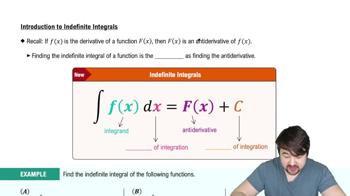
Indefinite Integrals and Integration Constants

Indefinite integrals represent families of functions differing by a constant, denoted as + C. This constant accounts for all possible antiderivatives since differentiation of a constant is zero.
Recommended video:
Guided course
05:04
Introduction to Indefinite Integrals