Ch. 7 - Transcendental Functions
Hass - Thomas' Calculus 15th Edition
Hass15th EditionThomas' CalculusISBN: 9780137616077Not the one you use?Change textbook
Chapter 7, Problem 7.7.55

Evaluate the integrals in Exercises 41–60.
55. ∫(from -π/4 to π/4)cosh(tanθ)sec²θ dθ

Verified step by step guidance
1
Identify the integral to evaluate: \(\int_{-\frac{\pi}{4}}^{\frac{\pi}{4}} \cosh(\tan \theta) \sec^{2} \theta \, d\theta\).
Recognize that the integrand contains \(\cosh(\tan \theta)\) and \(\sec^{2} \theta\), and note that the derivative of \(\tan \theta\) is \(\sec^{2} \theta\).
Use the substitution method by letting \(u = \tan \theta\). Then, compute \(du = \sec^{2} \theta \, d\theta\), which matches part of the integrand.
Change the limits of integration according to the substitution: when \(\theta = -\frac{\pi}{4}\), \(u = \tan(-\frac{\pi}{4}) = -1\); when \(\theta = \frac{\pi}{4}\), \(u = \tan(\frac{\pi}{4}) = 1\).
Rewrite the integral in terms of \(u\) as \(\int_{-1}^{1} \cosh(u) \, du\), which is easier to integrate.

Verified video answer for a similar problem:

This video solution was recommended by our tutors as helpful for the problem above.
Video duration:
2m

Key Concepts

Here are the essential concepts you must grasp in order to answer the question correctly.

Hyperbolic Cosine Function (cosh)

The hyperbolic cosine function, cosh(x), is defined as (e^x + e^(-x))/2. It is an even function and appears frequently in calculus involving hyperbolic functions. Understanding its properties helps in evaluating integrals where cosh is composed with other functions.
Recommended video:
Guided course
5:53
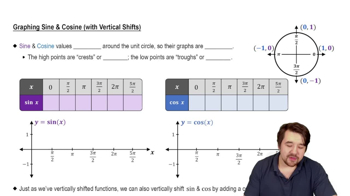
Graph of Sine and Cosine Function

Substitution Method in Integration

The substitution method involves changing variables to simplify an integral. By identifying a part of the integrand as a function whose derivative also appears, we can rewrite the integral in terms of a new variable, making it easier to evaluate.
Recommended video:
07:33
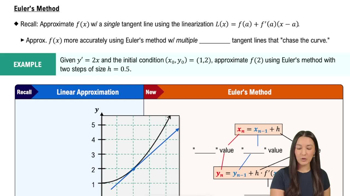
Euler's Method

Trigonometric Identities and Derivatives

Knowing the derivatives of trigonometric functions like tan(θ) and sec(θ) is essential. For example, the derivative of tan(θ) is sec²(θ), which often appears in integrals and suggests substitution opportunities. Recognizing these relationships aids in solving integrals involving trigonometric expressions.
Recommended video:
7:17
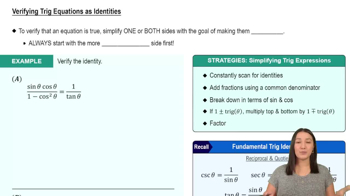
Verifying Trig Equations as Identities