5. e^(2t)-3e^t = 0
Ch. 7 - Transcendental Functions
Chapter 7, Problem 7.3.103
Evaluate the integrals in Exercises 97–110.
103. ∫₁⁴ (ln 2 · log₂x / x) dx
Verified step by step guidance1
Recognize that the integral is \( \int_1^4 \frac{\ln 2 \cdot \log_2 x}{x} \, dx \). Notice that \( \ln 2 \) is a constant and \( \log_2 x \) is the logarithm base 2 of \( x \).
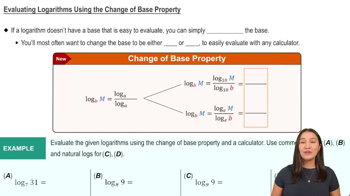
Recall the change of base formula for logarithms: \( \log_2 x = \frac{\ln x}{\ln 2} \). Substitute this into the integral to rewrite the integrand in terms of natural logarithms.
After substitution, the integrand becomes \( \frac{\ln 2 \cdot \frac{\ln x}{\ln 2}}{x} = \frac{\ln x}{x} \). This simplifies the integral to \( \int_1^4 \frac{\ln x}{x} \, dx \).
To solve \( \int \frac{\ln x}{x} \, dx \), use the substitution \( t = \ln x \), which implies \( dt = \frac{1}{x} dx \). This transforms the integral into \( \int t \, dt \).
Integrate \( \int t \, dt \) to get \( \frac{t^2}{2} + C \). Substitute back \( t = \ln x \) to express the antiderivative as \( \frac{(\ln x)^2}{2} + C \). Finally, evaluate this expression at the limits \( x=1 \) and \( x=4 \) to find the definite integral.

Verified video answer for a similar problem:
This video solution was recommended by our tutors as helpful for the problem above.
Video duration:
3mWas this helpful?
Key Concepts
Here are the essential concepts you must grasp in order to answer the question correctly.
Change of Logarithm Base
The integral involves logarithms with different bases (natural log and base 2). Converting all logarithms to a common base, typically the natural logarithm, simplifies the expression and makes integration manageable. Use the formula log_a(x) = ln(x) / ln(a) to rewrite log₂(x) in terms of ln(x).
Recommended video:
Change of Base Property
Properties of Logarithms
Understanding logarithm properties, such as the product, quotient, and power rules, helps simplify the integrand. In this problem, recognizing that ln(2)·log₂(x) can be expressed as ln(x) is key to reducing the integral to a simpler form that is easier to integrate.
Recommended video:
Change of Base Property
Integration of Logarithmic Functions
Integrating functions involving logarithms often requires techniques like substitution or integration by parts. For example, integrating (ln x)/x dx can be done by recognizing it as the derivative of (ln x)^2 / 2. Familiarity with these methods is essential to evaluate the integral correctly.
Recommended video:
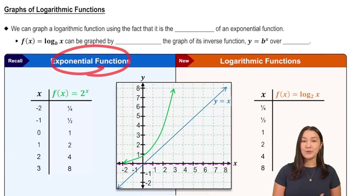
Graphs of Logarithmic Functions
Related Practice
Textbook Question
40
views
Textbook Question
130. Use the identity arccot(u)=π/2 - arctan(u) to derive the formula for the derivative of arccot(u) in Table 7.4 from the formula for the derivative of arctan(u).
32
views
Textbook Question
132. What is special about the functions
f(x) = arcsin((1/√(x²+1)) and g(x)=arctan(1/x)?
Explain.
26
views
Textbook Question
135. Find the area of the “triangular” region in the first quadrant that is bounded above by the curve y = e^(2x), below by the curve y = e^x, and on the right by the line x = ln(3).
23
views
Textbook Question
In Exercises 7–38, find the derivative of y with respect to x, t, or θ, as appropriate.
27. y = θ(sin(lnθ) + cos(lnθ))
22
views
Textbook Question
In Exercises 13–24, find the derivative of y with respect to the appropriate variable.
23. y = (x²+1)sech(ln x)
(Hint: Before differentiating, express in terms of exponentials and simplify.)
21
views