
Textbook Question
In Exercises 25–36, find the derivative of y with respect to the appropriate variable.
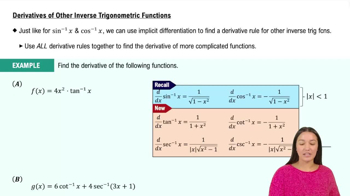
27. y = (1 - θ)tanh⁻¹(θ)
25
views

 Verified step by step guidance
 06:35
06:35 06:35
06:35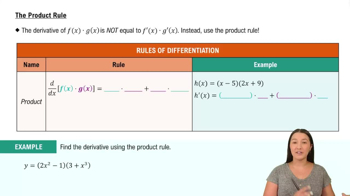 05:18
05:18In Exercises 25–36, find the derivative of y with respect to the appropriate variable.
27. y = (1 - θ)tanh⁻¹(θ)
17. Show that √(10x+1) and √(x+1) grow at the same rate as x→∞ by showing that they both grow at the same rate as √x as x→∞.
Since the hyperbolic functions can be expressed in terms of exponential functions, it is possible to express the inverse hyperbolic functions in terms of logarithms, as shown in the following table.
sinh⁻¹x = ln(x + √(x² + 1)), -∞ < x < ∞
cosh⁻¹x = ln(x + √(x² - 1)), x ≥ 1
tanh⁻¹x = (1/2)ln((1+x)/(1-x)), |x| < 1
sech⁻¹x = ln((1+√(1-x²))/x), 0 < x ≤ 1
csch⁻¹x = ln(1/x + √(1+x²)/|x|), x ≠ 1
coth⁻¹x = (1/2)ln((x+1)/(x-1)), |x| > 1
Use these formulas to express the numbers in Exercises 61–66 in terms of natural logarithms.
63. tanh⁻¹(-1/2)
In Exercises 7–26, find the derivative of y with respect to x, t, or θ, as appropriate.
y = cos(e^(-θ^2))
Evaluate the integrals in Exercises 91–102.
102. ∫(from -1/3 to 1/√3)(cos(arctan 3x))/(1+9x²) dx
In Exercises 115–126, use logarithmic differentiation or the method in Example 6 to find the derivative of y with respect to the given independent variable.
122. y = (ln x)^(ln x)