Ch. 7 - Transcendental Functions
Hass - Thomas' Calculus 15th Edition
Hass15th EditionThomas' CalculusISBN: 9780137616077Not the one you use?Change textbook
Chapter 7, Problem 7.3.122

In Exercises 115–126, use logarithmic differentiation or the method in Example 6 to find the derivative of y with respect to the given independent variable.
122. y = (ln x)^(ln x)

Verified step by step guidance
1
Recognize that the function is of the form \(y = (\ln x)^{\ln x}\), which is a variable base raised to a variable exponent. This is a perfect candidate for logarithmic differentiation.
Take the natural logarithm of both sides to simplify the expression: \(\ln y = \ln \left( (\ln x)^{\ln x} \right)\).
Use the logarithm power rule to bring down the exponent: \(\ln y = (\ln x) \cdot \ln (\ln x)\).
Differentiate both sides with respect to \(x\). Remember to use implicit differentiation on the left side and the product rule on the right side: \(\frac{1}{y} \frac{dy}{dx} = \frac{d}{dx} \left( (\ln x) \cdot \ln (\ln x) \right)\).
Apply the product rule to the right side: \(\frac{d}{dx} (\ln x) \cdot \ln (\ln x) + (\ln x) \cdot \frac{d}{dx} \ln (\ln x)\). Then find each derivative separately using the chain rule, and finally multiply both sides by \(y\) to solve for \(\frac{dy}{dx}\).

Verified video answer for a similar problem:

This video solution was recommended by our tutors as helpful for the problem above.
Video duration:
5m
Was this helpful?

Key Concepts

Here are the essential concepts you must grasp in order to answer the question correctly.

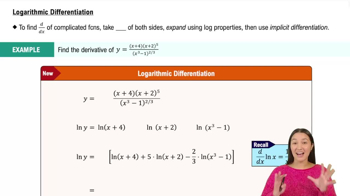
Logarithmic Differentiation

Logarithmic differentiation is a technique used to differentiate functions where both the base and the exponent are variable expressions. By taking the natural logarithm of both sides, the function is transformed into a product or sum, simplifying differentiation using the chain and product rules.
Recommended video:
06:30
Logarithmic Differentiation

Properties of Logarithms

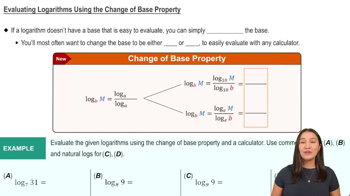
Understanding logarithm properties, such as ln(a^b) = b ln(a), is essential for rewriting complex expressions. These properties allow the exponent to be brought down as a multiplier, making differentiation more straightforward when dealing with functions like (ln x)^(ln x).
Recommended video:
05:36
Change of Base Property

Chain Rule and Product Rule

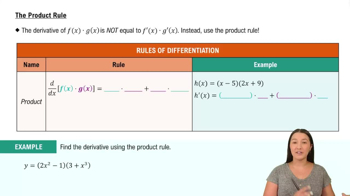
The chain rule is used to differentiate composite functions, while the product rule applies when differentiating products of functions. In logarithmic differentiation, after applying logarithms, these rules are often combined to find the derivative of the transformed expression.
Recommended video:
05:18
The Product Rule
Related Practice
Textbook Question

Since the hyperbolic functions can be expressed in terms of exponential functions, it is possible to express the inverse hyperbolic functions in terms of logarithms, as shown in the following table.

sinh⁻¹x = ln(x + √(x² + 1)), -∞ < x < ∞

cosh⁻¹x = ln(x + √(x² - 1)), x ≥ 1

tanh⁻¹x = (1/2)ln((1+x)/(1-x)), |x| < 1

sech⁻¹x = ln((1+√(1-x²))/x), 0 < x ≤ 1

csch⁻¹x = ln(1/x + √(1+x²)/|x|), x ≠ 1

coth⁻¹x = (1/2)ln((x+1)/(x-1)), |x| > 1

Use these formulas to express the numbers in Exercises 61–66 in terms of natural logarithms.

63. tanh⁻¹(-1/2)

35
views
Textbook Question

130. Where does the periodic function f(x) = 2e^(sin(x/2)) take on its extreme values, and what are these values?

18
views
Textbook Question

25. First-order chemical reactions In some chemical reactions, the rate at which the amount of a substance changes with time is proportional to the amount present. For the change of δ-gluconolactone into gluconic acid, for example,

dy/dt = -0.6y

when t is measured in hours. If there are 100 grams of δ-gluconolactone present when t=0, how many grams will be left after the first hour?

55
views
Textbook Question

In Exercises 25–36, find the derivative of y with respect to the appropriate variable.

31. y = cos⁻¹(x) - x sech⁻¹(x)

25
views
Textbook Question

Evaluate the integrals in Exercises 91–102.

102. ∫(from -1/3 to 1/√3)(cos(arctan 3x))/(1+9x²) dx

32
views
Textbook Question

In Exercises 57–70, use logarithmic differentiation to find the derivative of y with respect to the given independent variable.

66. y = θsin(θ)/√(sec(θ))

40
views