Area: Find the area enclosed by the ellipse x²/a² + y²/b² = 1.
Ch. 8 - Techniques of Integration
Chapter 8, Problem 8.5.42
Evaluate the integrals in Exercises 39–54.
∫ sin(θ) dθ / (cos²θ + cos θ - 2)
Verified step by step guidance1
Start by examining the integral: \(\int \frac{\sin(\theta)}{\cos^{2}(\theta) + \cos(\theta) - 2} \, d\theta\). Notice that the denominator is a quadratic expression in terms of \(\cos(\theta)\).
Let \(u = \cos(\theta)\). Then, compute \(du = -\sin(\theta) \, d\theta\), which implies \(-du = \sin(\theta) \, d\theta\). This substitution will help simplify the integral.
Rewrite the integral in terms of \(u\): replace \(\sin(\theta) \, d\theta\) with \(-du\), and the denominator becomes \(u^{2} + u - 2\). So the integral becomes \(\int \frac{-du}{u^{2} + u - 2}\).
Factor the quadratic in the denominator: \(u^{2} + u - 2 = (u + 2)(u - 1)\). This allows you to use partial fraction decomposition to express \(\frac{1}{(u + 2)(u - 1)}\) as a sum of simpler fractions.
Set up the partial fractions: \(\frac{1}{(u + 2)(u - 1)} = \frac{A}{u + 2} + \frac{B}{u - 1}\). Solve for constants \(A\) and \(B\), then integrate each term separately with respect to \(u\).

Verified video answer for a similar problem:
This video solution was recommended by our tutors as helpful for the problem above.
Video duration:
3mWas this helpful?
Key Concepts
Here are the essential concepts you must grasp in order to answer the question correctly.
Integration of Trigonometric Functions
This involves techniques to integrate functions containing sine, cosine, and other trigonometric expressions. Recognizing patterns and using identities can simplify the integral, making it easier to solve.
Recommended video:
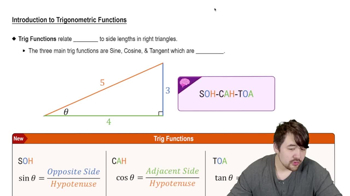
Introduction to Trigonometric Functions
Trigonometric Identities and Factorization
Using identities like factoring quadratic expressions in terms of cosine helps simplify the denominator. For example, factoring cos²θ + cosθ - 2 into (cosθ + 2)(cosθ - 1) can make the integral more manageable.
Recommended video:
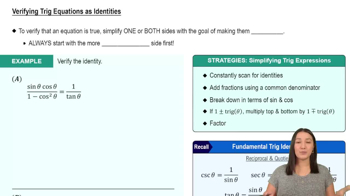
Verifying Trig Equations as Identities
Substitution Method in Integration
Substitution involves changing variables to simplify the integral. Here, letting u = cosθ transforms the integral into a rational function in u, which is easier to integrate.
Recommended video:
Euler's Method
Related Practice
Textbook Question
70
views
Textbook Question
Evaluate the integrals in Exercises 1–14.
∫ 5 dx / √(25x² - 9), where x > 3/5
35
views
Textbook Question
Use any method to evaluate the integrals in Exercises 15–38. Most will require trigonometric substitutions, but some can be evaluated by other methods.
∫ dx / (4 - x²)^(3/2) from 0 to 1
23
views
Textbook Question
The integrals in Exercises 1–34 converge. Evaluate the integrals without using tables.
∫₋∞^∞ 2x e^(−x²) dx
37
views
Textbook Question
In Exercises 27–40, use a substitution to change the integral into one you can find in the table. Then evaluate the integral.
∫ (√2 - x) / √x dx
29
views
Textbook Question
The integrals in Exercises 1–44 are in no particular order. Evaluate each integral using any algebraic method, trigonometric identity, or substitution you think is appropriate.
∫ (dt / t√(3 + t²)
25
views