Area: Find the area enclosed by the ellipse x²/a² + y²/b² = 1.
Ch. 8 - Techniques of Integration
Chapter 8, Problem 8.8.24
The integrals in Exercises 1–34 converge. Evaluate the integrals without using tables.
∫₋∞^∞ 2x e^(−x²) dx
Verified step by step guidance1
Recognize that the integral is an improper integral over the entire real line, from \(-\infty\) to \(\infty\), of the function \(2x e^{-x^{2}}\).
Note that the integrand \(2x e^{-x^{2}}\) is an odd function because \(2(-x) e^{-(-x)^{2}} = -2x e^{-x^{2}}\), which is the negative of the original function.
Recall that the integral of any odd function over symmetric limits \([-a, a]\) is zero, provided the integral converges.
Since the limits are \(-\infty\) to \(\infty\), which are symmetric about zero, and the function is odd and integrable, the integral evaluates to zero.
Therefore, without performing any integration by parts or substitution, conclude that the value of the integral is zero due to the symmetry of the integrand.

Verified video answer for a similar problem:
This video solution was recommended by our tutors as helpful for the problem above.
Video duration:
7mWas this helpful?
Key Concepts
Here are the essential concepts you must grasp in order to answer the question correctly.
Improper Integrals
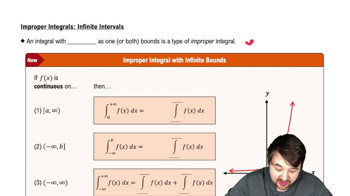
Improper integrals involve integration over infinite limits or integrands with infinite discontinuities. To evaluate them, one typically takes limits of definite integrals as the bounds approach infinity. Understanding convergence is crucial to ensure the integral has a finite value.
Recommended video:
Improper Integrals: Infinite Intervals
Properties of Even and Odd Functions
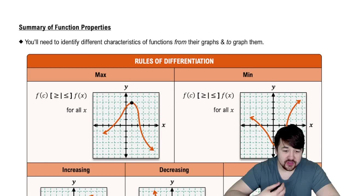
Even functions satisfy f(−x) = f(x), and odd functions satisfy f(−x) = −f(x). When integrating over symmetric limits (−a to a), the integral of an odd function is zero, while the integral of an even function is twice the integral from 0 to a. Recognizing function symmetry simplifies evaluation.
Recommended video:
Properties of Functions
Integration of Exponential Functions with Quadratic Exponents
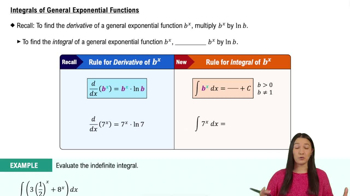
Integrals involving e^(−x²) are common in calculus and probability. While the integral of e^(−x²) has no elementary antiderivative, multiplying by x or other polynomials can allow evaluation using substitution or recognizing derivative forms. This helps in solving integrals like ∫ x e^(−x²) dx.
Recommended video:
Integrals of General Exponential Functions
Related Practice
Textbook Question
70
views
Textbook Question
Evaluate the integrals in Exercises 1–14.
∫ 5 dx / √(25x² - 9), where x > 3/5
35
views
Textbook Question
Evaluate the integrals in Exercises 39–54.
∫ sin(θ) dθ / (cos²θ + cos θ - 2)
6
views
Textbook Question
[Technology Exercise] When solving Exercises 33-40, you may need to use a calculator or a computer.
Find, to two decimal places, the areas of the surfaces generated by revolving the curves in Exercises 35 and 36 about the x-axis.
y = x²/4, 0 ≤ x ≤ 2
28
views
Textbook Question
In Exercises 9–16, express the integrand as a sum of partial fractions and evaluate the integrals.
∫ (x + 3) / (2x³ - 8x) dx
19
views
Textbook Question
The integrals in Exercises 1–44 are in no particular order. Evaluate each integral using any algebraic method, trigonometric identity, or substitution you think is appropriate.
∫ (dt / t√(3 + t²)
25
views