2. When applying the formula for integration by parts, how do you choose the u and dv? How can you apply integration by parts to an integral of the form ∫ f(x) dx?
Ch. 8 - Techniques of Integration
Chapter 8, Problem 8.AAE.11
Finding arc length
Find the length of the curve
y = ∫ from 0 to x of √(cos(2t)) dt, 0 ≤ x ≤ π/4.
Verified step by step guidance1
Recognize that the curve is defined by an integral function: \(y = \int_0^x \sqrt{\cos(2t)} \, dt\). To find the arc length of \(y\) from \(x=0\) to \(x=\frac{\pi}{4}\), we use the arc length formula for a function \(y=f(x)\): \(L = \int_a^b \sqrt{1 + \left(\frac{dy}{dx}\right)^2} \, dx\).
Find the derivative \(\frac{dy}{dx}\) using the Fundamental Theorem of Calculus. Since \(y\) is defined as an integral with variable upper limit \(x\), we have \(\frac{dy}{dx} = \sqrt{\cos(2x)}\).
Substitute \(\frac{dy}{dx}\) into the arc length formula: \(L = \int_0^{\frac{\pi}{4}} \sqrt{1 + \left(\sqrt{\cos(2x)}\right)^2} \, dx\).
Simplify the expression inside the square root: \(\left(\sqrt{\cos(2x)}\right)^2 = \cos(2x)\), so the integrand becomes \(\sqrt{1 + \cos(2x)}\).
Use a trigonometric identity to simplify \(1 + \cos(2x)\). Recall that \(1 + \cos(2x) = 2 \cos^2(x)\). Therefore, the integrand simplifies to \(\sqrt{2 \cos^2(x)} = \sqrt{2} |\cos(x)|\). Since \(x\) is in \([0, \frac{\pi}{4}]\) where \(\cos(x)\) is positive, the absolute value can be removed. The arc length integral becomes \(L = \int_0^{\frac{\pi}{4}} \sqrt{2} \cos(x) \, dx\).

Verified video answer for a similar problem:
This video solution was recommended by our tutors as helpful for the problem above.
Video duration:
4mKey Concepts
Here are the essential concepts you must grasp in order to answer the question correctly.
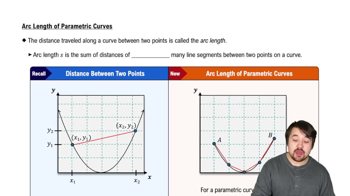
Arc Length Formula for Parametric and Integral-Defined Curves
The arc length of a curve y = f(x) from a to b is given by the integral of the square root of 1 plus the derivative squared, ∫_a^b √(1 + (dy/dx)^2) dx. When y is defined as an integral function, this formula still applies by first finding dy/dx.
Recommended video:
Guided course
Arc Length of Parametric Curves
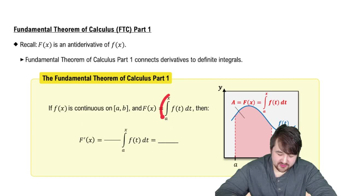
Fundamental Theorem of Calculus
This theorem connects differentiation and integration, stating that if y = ∫_0^x g(t) dt, then dy/dx = g(x). It allows us to find the derivative of an integral-defined function, which is essential for computing the arc length.
Recommended video:
Guided course
Fundamental Theorem of Calculus Part 1
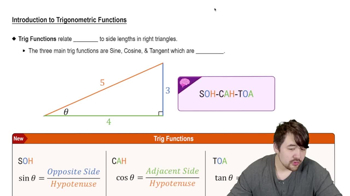
Handling Square Roots of Trigonometric Functions
The integrand involves √(cos(2t)), which requires understanding the domain where cos(2t) is non-negative to ensure the square root is real. Recognizing trigonometric identities and domain restrictions helps in evaluating or simplifying the integral.
Recommended video:
Guided course
Introduction to Trigonometric Functions
Related Practice
Textbook Question
23
views
Textbook Question
18. Finding volume (Continuation of Exercise 17.) Find the volume of the solid generated by revolving the region R about:
a. the y-axis.
38
views
Textbook Question
Evaluate the integrals in Exercises 1–6.
∫ dt / (t - √(1 - t²))
30
views
Textbook Question
7. What is the goal of the method of partial fractions?
4
views
Textbook Question
Evaluate the integrals in Exercises 69–134. The integrals are listed in random order so you need to decide which integration technique to use.
∫ dy / (y² − 2y + 2)
17
views
Textbook Question
Use the substitutions in Equations (1)–(4) to evaluate the integrals in Exercises 33–40. Integrals like these arise in calculating the average angular velocity of the output shaft of a universal joint when the input and output shafts are not aligned.
∫(from π/2 to 2π/3) cos θ dθ / (sin θ cos θ + sin θ)
36
views