
Finding volume
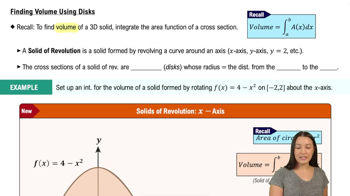
Let R be the "triangular" region in the first quadrant that is bounded above by the line y = 1, below by the curve y = ln x, and on the left by the line x = 1.
Find the volume of the solid generated by revolving R about
a. the x-axis.
Verified step by step guidance
Finding volume
Let R be the "triangular" region in the first quadrant that is bounded above by the line y = 1, below by the curve y = ln x, and on the left by the line x = 1.
Find the volume of the solid generated by revolving R about
a. the x-axis.
Use any method to evaluate the integrals in Exercises 15–38. Most will require trigonometric substitutions, but some can be evaluated by other methods.
∫ dx / (4 - x²)^(3/2) from 0 to 1
The integrals in Exercises 1–34 converge. Evaluate the integrals without using tables.
∫₋∞^∞ 2x e^(−x²) dx
Evaluate the integrals in Exercises 31–56. Some integrals do not require integration by parts.
∫ (cos(√x))/(√x) dx
Length of a curve
Find the length of the curve
y = ∫(from 1 to x) sqrt(sqrt(t) - 1) dt, where 1 ≤ x ≤ 16.
For each x > 0, let G(x) = ∫(from 0 to x) e^(-xt) dt. Prove that xG(x) = 1 for each x > 0.