Ch. 4 - Inverse, Exponential, and Logarithmic Functions
Lial - College Algebra 13th Edition
Lial13th EditionCollege AlgebraISBN: 9780136881063Not the one you use?Change textbook
Chapter 5, Problem 55

Graph each function. Give the domain and range. ƒ(x) = (1/3)-x+1

Verified step by step guidance
1
Identify the given function: \(f(x) = \left(\frac{1}{3}\right)^{-x+1}\). Recognize that this is an exponential function with base \(\frac{1}{3}\) and an exponent of \(-x + 1\).
Rewrite the exponent to better understand the function's behavior: \(-x + 1\) can be written as \$1 - x$. So, \(f(x) = \left(\frac{1}{3}\right)^{1 - x}\).
Recall that \(\left(\frac{1}{3}\right)^{1 - x} = \left(\frac{1}{3}\right)^1 \cdot \left(\frac{1}{3}\right)^{-x} = \frac{1}{3} \cdot 3^x\), since \(\left(\frac{1}{3}\right)^{-x} = 3^x\). This helps to see the function as \(f(x) = \frac{1}{3} \cdot 3^x\).
Determine the domain: Since the function is exponential, the domain is all real numbers, so \(\text{Domain} = (-\infty, \infty)\).
Determine the range: Exponential functions with positive bases and real exponents produce positive outputs. Since \$3^x > 0\( for all \)x$, and multiplying by \(\frac{1}{3}\) keeps it positive, the range is \(\text{Range} = (0, \infty)\).

Verified video answer for a similar problem:

This video solution was recommended by our tutors as helpful for the problem above.
Video duration:
9m
Was this helpful?

Key Concepts

Here are the essential concepts you must grasp in order to answer the question correctly.

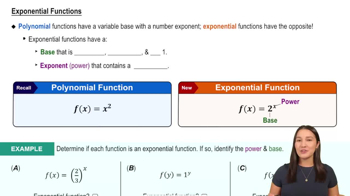
Exponential Functions

An exponential function has the form f(x) = a^x, where the base a is a positive real number not equal to 1. In this problem, the function involves a base of 1/3 raised to a linear expression in x. Understanding how the exponent affects the function's growth or decay is essential for graphing.
Recommended video:
6:13
Exponential Functions

Domain and Range of Exponential Functions

The domain of an exponential function is all real numbers since any real number can be substituted for x. The range depends on the base and transformations; for positive bases, the range is typically all positive real numbers. Identifying these sets helps describe the function's behavior fully.
Recommended video:
4:22
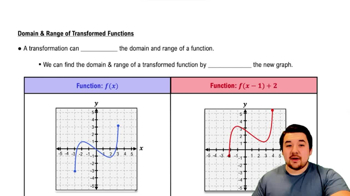
Domain & Range of Transformed Functions

Transformations of Functions

Transformations such as shifts, reflections, and stretches affect the graph of a function. Here, the exponent is (-x + 1), which includes a reflection across the y-axis and a horizontal shift. Recognizing these changes helps accurately sketch the graph and understand its shape.
Recommended video:
4:22
Domain & Range of Transformed Functions