Table of contents
- 0. Review of Algebra4h 18m
- 1. Equations & Inequalities3h 18m
- 2. Graphs of Equations1h 43m
- 3. Functions2h 17m
- 4. Polynomial Functions1h 44m
- 5. Rational Functions1h 23m
- 6. Exponential & Logarithmic Functions2h 28m
- 7. Systems of Equations & Matrices4h 5m
- 8. Conic Sections2h 23m
- 9. Sequences, Series, & Induction1h 22m
- 10. Combinatorics & Probability1h 45m
3. Functions
Intro to Functions & Their Graphs
Problem 67
Textbook Question
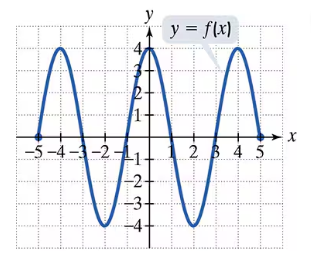
In Exercises 65–70, use the graph of f to find each indicated function value. f(4)

Verified step by step guidance1
Step 1: Understand the problem. The goal is to find the value of the function f(x) when x = 4. This means we need to locate the point on the graph of f where the x-coordinate is 4 and determine the corresponding y-coordinate.
Step 2: Locate x = 4 on the x-axis of the graph. This is the horizontal axis, and you should find the point where x equals 4.
Step 3: From x = 4, move vertically (up or down) until you intersect the graph of the function f. This intersection point represents the value of the function at x = 4.
Step 4: Identify the y-coordinate of the intersection point. The y-coordinate of this point is the value of f(4).
Step 5: Write down the result as f(4) = [y-coordinate], where [y-coordinate] is the value you found in the previous step.
Verified video answer for a similar problem:This video solution was recommended by our tutors as helpful for the problem above
Video duration:
1mPlay a video:
Was this helpful?
Key Concepts
Here are the essential concepts you must grasp in order to answer the question correctly.
Function Notation
Function notation, such as f(x), is a way to denote a function's output for a given input x. In this context, f(4) represents the value of the function f when the input is 4. Understanding function notation is essential for interpreting and evaluating functions correctly.
Recommended video:
Interval Notation
Graph Interpretation
Interpreting a graph involves analyzing the visual representation of a function to determine its values at specific points. For the question, locating the point on the graph where x equals 4 allows us to find the corresponding y-value, which is f(4). This skill is crucial for understanding how functions behave visually.
Recommended video:
Guided course
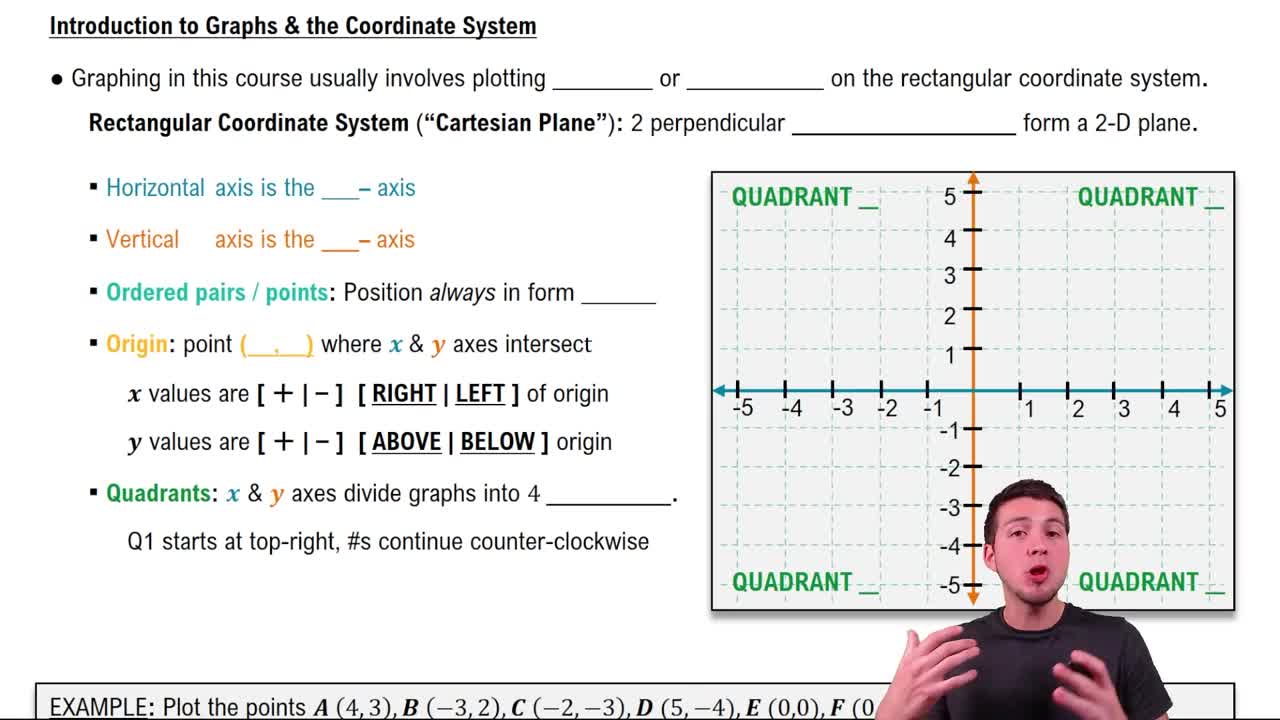
Graphs and Coordinates - Example
Domain and Range
The domain of a function is the set of all possible input values (x-values), while the range is the set of all possible output values (y-values). Knowing the domain and range helps in understanding the limits of the function's inputs and outputs, which is important when evaluating specific function values like f(4).
Recommended video:
Domain & Range of Transformed Functions
Watch next
Master Relations and Functions with a bite sized video explanation from Patrick
Start learningRelated Videos
Related Practice
Textbook Question
Determine whether each equation has a graph that is symmetric with respect to the x-axis, the y-axis, the origin, or none of these. |x| = |y|
513
views