Use an end behavior diagram, as shown below, to describe the end behavior of the graph of each polynomial function. ƒ(x)=4x7-x5+x3-1
Ch. 3 - Polynomial and Rational Functions

Chapter 4, Problem 23
Graph each quadratic function. Give the (a) vertex, (b) axis, (c) domain, and (d) range. ƒ(x) = (x - 2)2
Verified step by step guidance1
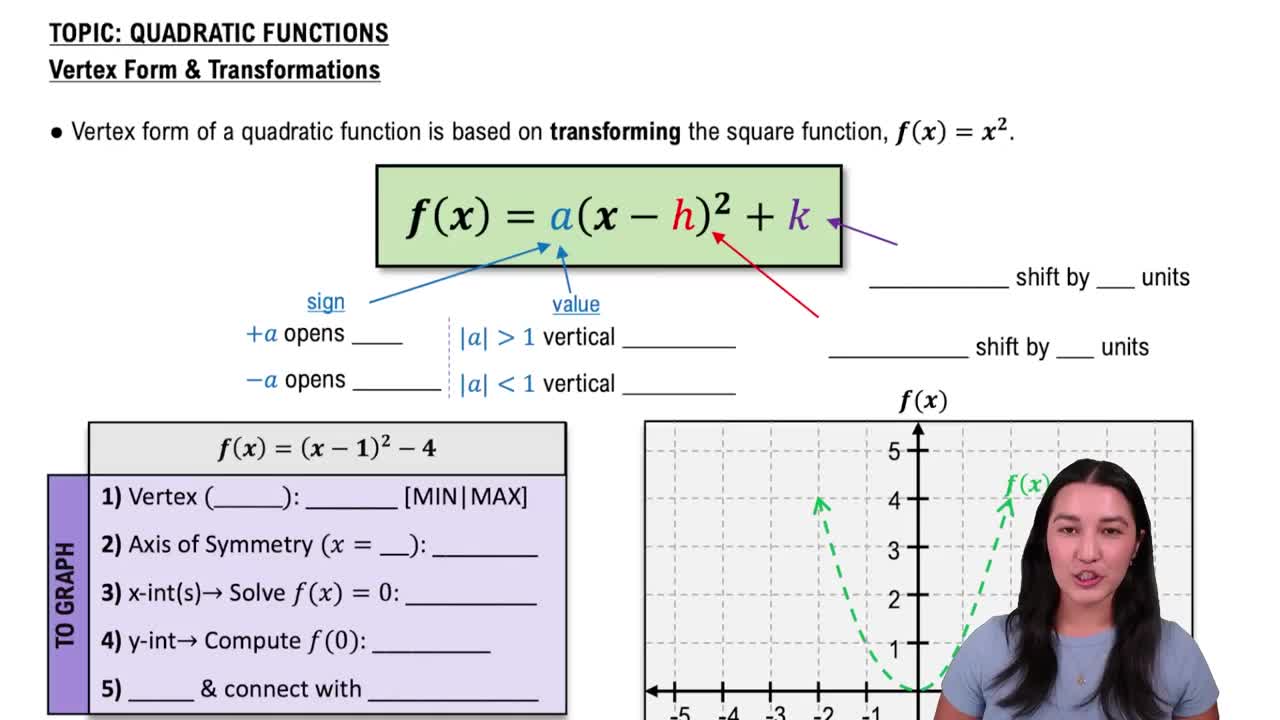
Identify the given quadratic function: \(f(x) = (x - 2)^2\). This is in vertex form, which is \(f(x) = a(x - h)^2 + k\), where \((h, k)\) is the vertex.
Find the vertex by comparing \(f(x) = (x - 2)^2\) to the vertex form. Here, \(h = 2\) and \(k = 0\), so the vertex is at \((2, 0)\).
Determine the axis of symmetry, which is the vertical line that passes through the vertex. The axis is \(x = 2\).
State the domain of the function. Since this is a quadratic function, the domain is all real numbers, written as \((-\infty, \infty)\).
Find the range by considering the vertex and the direction the parabola opens. Since \(a = 1 > 0\), the parabola opens upward, so the range is \([0, \infty)\).
Key Concepts
Here are the essential concepts you must grasp in order to answer the question correctly.
Vertex of a Quadratic Function
The vertex is the highest or lowest point on the graph of a quadratic function, representing its maximum or minimum value. For functions in the form f(x) = (x - h)^2 + k, the vertex is at (h, k). In this question, the vertex is at (2, 0), indicating the parabola opens upward from this point.
Recommended video:
Vertex Form
Axis of Symmetry
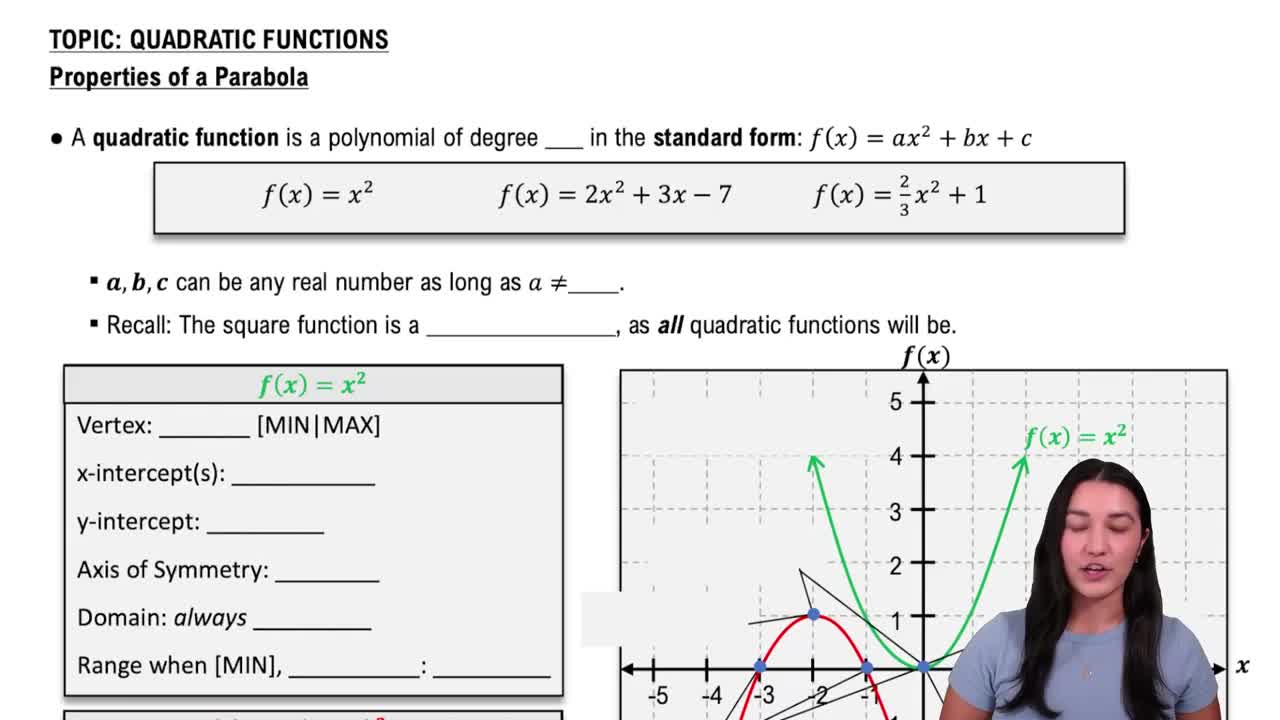
The axis of symmetry is a vertical line that divides the parabola into two mirror-image halves. It passes through the vertex and has the equation x = h for a quadratic in vertex form. Here, the axis of symmetry is x = 2, reflecting the parabola's symmetry about this line.
Recommended video:
Properties of Parabolas
Domain and Range of Quadratic Functions
The domain of any quadratic function is all real numbers since x can take any value. The range depends on the vertex and the parabola's direction; for f(x) = (x - 2)^2, the parabola opens upward with a minimum at y = 0, so the range is y ≥ 0.
Recommended video:
Domain & Range of Transformed Functions
Related Practice
Textbook Question
1001
views
Textbook Question
Use an end behavior diagram, as shown below, to describe the end behavior of the graph of each polynomial function. ƒ(x)=-x3-4x2+2x-1
936
views
Textbook Question
Use one of the end behavior diagrams below, to describe the end behavior of the graph of each polynomial function.
829
views
Textbook Question
Use synthetic division to perform each division. x7+1 / x+1
385
views
Textbook Question
Write each formula as an English phrase using the word varies or proportional. r = d/t, where r is the speed when traveling d miles in t hours.
537
views
Textbook Question
Solve each polynomial inequality. Give the solution set in interval notation.
(a) -x(x - 1)(x - 2) ≥ 0
(b) -x(x - 1)(x - 2) > 0
(c) -x(x - 1)(x - 2) ≤ 0
(d) -x(x - 1)(x - 2) < 0
523
views