Ch. R - Review of Basic Concepts
Lial - College Algebra 13th Edition
Lial13th EditionCollege AlgebraISBN: 9780136881063Not the one you use?Change textbook
Chapter 1, Problem 65

Use the rules for radicals to perform the indicated operations. Assume all variable expressions represent positive real numbers. ∛√4

Verified step by step guidance
1
Recognize that the expression involves nested radicals: the cube root of the square root of 4, which can be written as \(\sqrt[3]{\sqrt{4}}\).
Rewrite the square root as an exponent: \(\sqrt{4} = 4^{\frac{1}{2}}\).
Substitute this back into the original expression: \(\sqrt[3]{4^{\frac{1}{2}}}\).
Use the rule for radicals that \(\sqrt[n]{a^m} = a^{\frac{m}{n}}\) to combine the radicals: \(\left(4^{\frac{1}{2}}\right)^{\frac{1}{3}} = 4^{\frac{1}{2} \times \frac{1}{3}}\).
Multiply the exponents: \(4^{\frac{1}{6}}\), which is the simplified form of the original expression.

Verified video answer for a similar problem:

This video solution was recommended by our tutors as helpful for the problem above.
Video duration:
1m

Key Concepts

Here are the essential concepts you must grasp in order to answer the question correctly.

Radical Expressions and Notation

Radical expressions involve roots such as square roots (√) and cube roots (∛). The index of the root indicates the degree, with √ representing a square root (index 2) and ∛ representing a cube root (index 3). Understanding how to interpret and write these expressions is fundamental to manipulating them.
Recommended video:
05:45
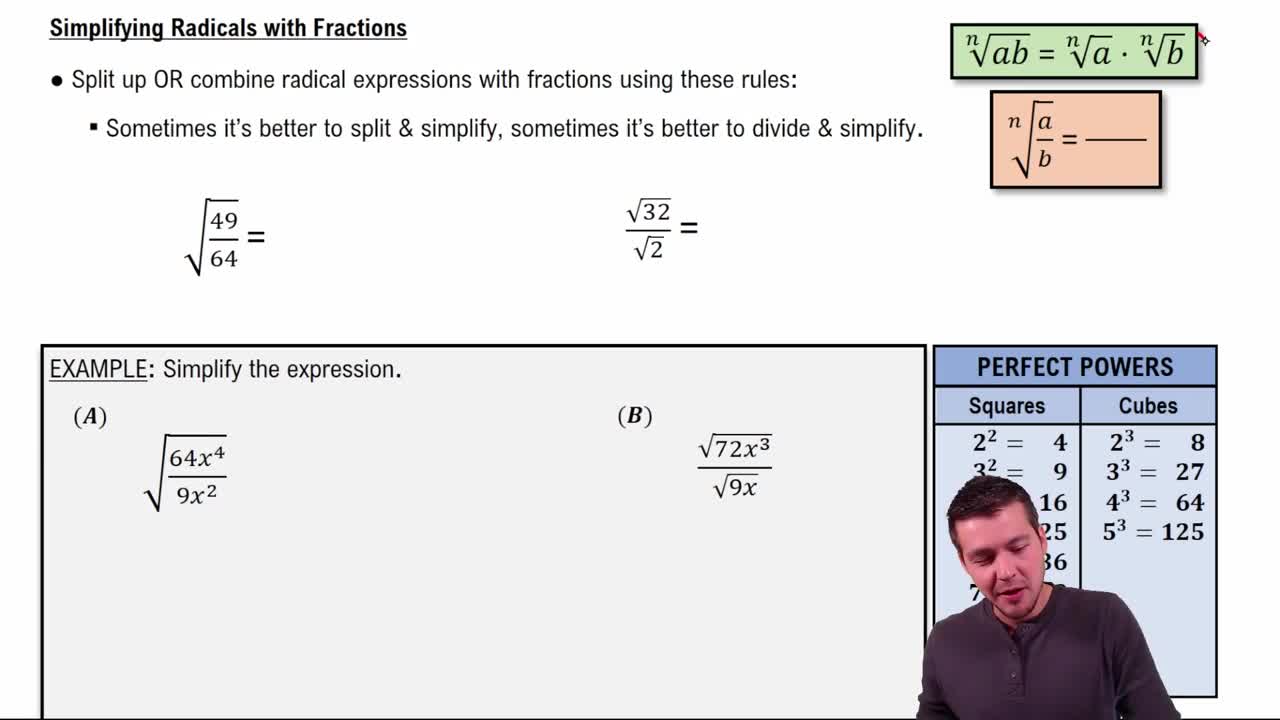
Radical Expressions with Fractions

Rules for Radicals (Product and Power Rules)

The rules for radicals allow simplification and combination of roots. The product rule states that the root of a product equals the product of the roots, e.g., √a * √b = √(ab). The power rule lets you rewrite radicals as fractional exponents, such as √a = a^(1/2) and ∛a = a^(1/3), facilitating easier operations.
Recommended video:
5:50
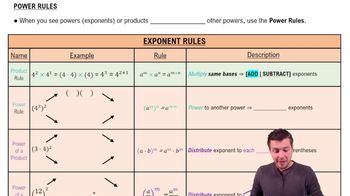
Power Rules

Converting Between Radical and Exponential Forms

Expressing radicals as fractional exponents helps simplify complex expressions. For example, √4 can be written as 4^(1/2), and ∛(4^(1/2)) becomes 4^(1/2 * 1/3) = 4^(1/6). This conversion is key to performing operations like multiplication or composition of radicals efficiently.
Recommended video:
04:34
Converting Standard Form to Vertex Form