The atomic radius of Pb is 175 pm, and the density is 11.34 g>cm3. Does lead have a primitive cubic structure or a face-centered cubic structure?
Verified step by step guidance
1
Step 1: First, we need to understand the difference between a primitive cubic structure and a face-centered cubic structure. In a primitive cubic structure, each unit cell has atoms at its corners only. In a face-centered cubic structure, each unit cell has atoms at its corners and the center of each face.
Step 2: Next, we need to calculate the volume of one atom. The atomic radius of Pb is given as 175 pm. We can convert this to cm (1 pm = 1e-10 cm). The volume of one atom can be calculated using the formula for the volume of a sphere, which is (4/3)πr^3.
Step 3: Then, we need to calculate the volume of the unit cell. For a primitive cubic structure, there is one atom per unit cell. For a face-centered cubic structure, there are four atoms per unit cell. So, the volume of the unit cell is the volume of one atom multiplied by the number of atoms per unit cell.
Step 4: After that, we calculate the mass of the unit cell. The atomic mass of Pb is 207.2 g/mol. We can convert this to grams per atom using Avogadro's number (1 mol = 6.022e23 atoms). The mass of the unit cell is the mass of one atom multiplied by the number of atoms per unit cell.
Step 5: Finally, we calculate the density of the unit cell using the formula density = mass/volume. We compare this calculated density with the given density of Pb (11.34 g/cm^3). If they are approximately equal, then the assumed structure (primitive cubic or face-centered cubic) is correct. If not, we need to assume the other structure and repeat the calculations.
Verified video answer for a similar problem:
This video solution was recommended by our tutors as helpful for the problem above.
Video duration:
4m
Play a video:
Was this helpful?
Key Concepts
Here are the essential concepts you must grasp in order to answer the question correctly.
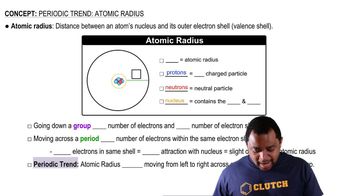
Atomic Radius
The atomic radius is a measure of the size of an atom, typically defined as the distance from the nucleus to the outermost electron shell. In the context of solid metals, the atomic radius can influence the packing arrangement of atoms in a crystal lattice, which is crucial for determining the type of crystal structure.
Crystal structures refer to the orderly arrangement of atoms in a crystalline solid. The two common types are primitive cubic (where atoms are located only at the corners of the cube) and face-centered cubic (where atoms are at the corners and the centers of each face). The arrangement affects properties like density and atomic packing efficiency.
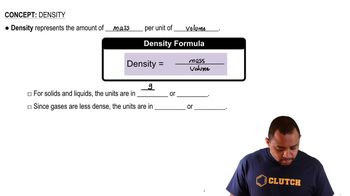
Density is defined as mass per unit volume and is influenced by the arrangement of atoms in a crystal structure. In face-centered cubic structures, atoms are more closely packed than in primitive cubic structures, leading to higher density. Calculating density from atomic radius can help determine the type of crystal structure present in a material.