Consider the following endothermic reaction of gaseous AB3 molecules with A2 molecules. Identify the true statement about the spontaneity of the reaction. (a) The reaction is likely to be spontaneous at high temperatures. (b) The reaction is likely to be spontaneous at high temperatures. (c) The reaction is always spontaneous.(d) The reaction is always spontaneous.
Verified step by step guidance
1
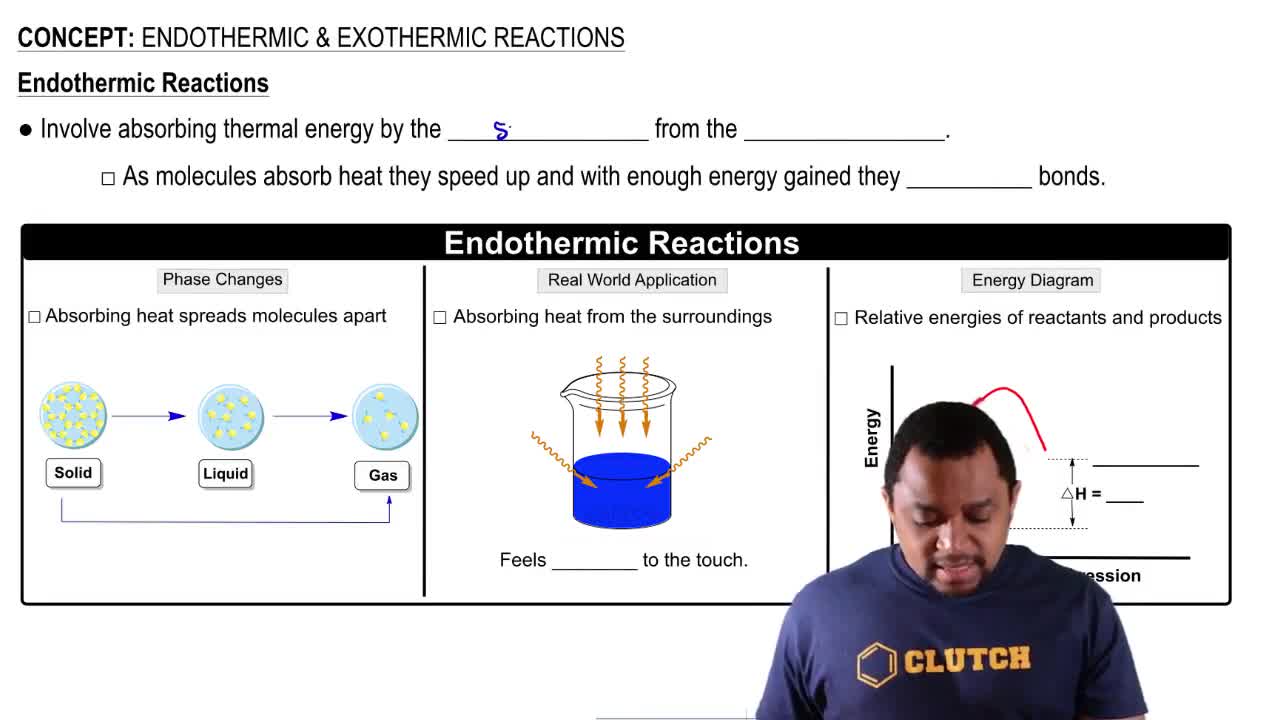
Step 1: Identify the reaction as endothermic, meaning it absorbs heat from the surroundings.
Step 2: Recall that for an endothermic reaction, the change in enthalpy (ΔH) is positive.
Step 3: Use the Gibbs free energy equation, ΔG = ΔH - TΔS, to determine spontaneity. For a reaction to be spontaneous, ΔG must be negative.
Step 4: Recognize that increasing temperature (T) can make the TΔS term larger, potentially making ΔG negative if ΔS is positive.
Step 5: Conclude that the reaction is more likely to be spontaneous at high temperatures if the entropy change (ΔS) is positive.
Verified video answer for a similar problem:
This video solution was recommended by our tutors as helpful for the problem above.
Video duration:
1m
Play a video:
Was this helpful?
Key Concepts
Here are the essential concepts you must grasp in order to answer the question correctly.
Endothermic Reactions
Endothermic reactions are chemical processes that absorb heat from their surroundings, resulting in a decrease in temperature of the environment. In these reactions, the enthalpy change (ΔH) is positive, indicating that energy is required for the reaction to proceed. Understanding this concept is crucial for analyzing the spontaneity of reactions, as it influences how temperature affects the reaction's favorability.
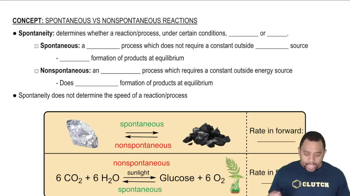
The spontaneity of a reaction refers to its ability to occur without external intervention. It is determined by the change in Gibbs free energy (ΔG), where a negative ΔG indicates a spontaneous process. For endothermic reactions, temperature plays a significant role; at higher temperatures, the entropy change (ΔS) can outweigh the positive enthalpy change, potentially making the reaction spontaneous.
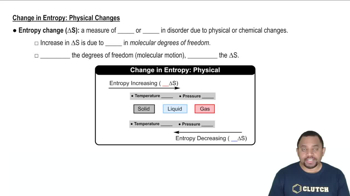
Temperature and entropy are key factors in determining the spontaneity of a reaction. Entropy (ΔS) measures the disorder or randomness of a system, and an increase in entropy generally favors spontaneity. In endothermic reactions, as temperature increases, the contribution of the TΔS term in the Gibbs free energy equation (ΔG = ΔH - TΔS) can lead to a negative ΔG, thus promoting spontaneity at elevated temperatures.