What is a semimetal, and where in the periodic table are semimetals found?
Verified step by step guidance
1
Understand that a semimetal, also known as a metalloid, is a type of element that has properties intermediate between metals and nonmetals. They are not as conductive as metals but are more conductive than nonmetals.
Recognize that semimetals can form alloys with metals and can also form covalent compounds with nonmetals, showcasing their intermediate chemical properties.
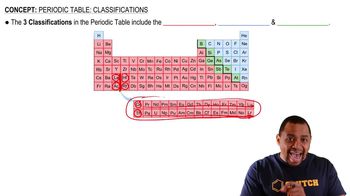
Identify the location of semimetals in the periodic table: they are typically found along the zig-zag line (staircase line) that separates metals from nonmetals. This line starts between boron and aluminum and extends down between polonium and astatine.
Note the common semimetals which include boron (B), silicon (Si), germanium (Ge), arsenic (As), antimony (Sb), tellurium (Te), and sometimes polonium (Po).
Understand that the position of semimetals in the periodic table influences their unique properties, making them useful in various applications such as semiconductors in electronics due to their ability to conduct electricity under certain conditions.
Verified video answer for a similar problem:
This video solution was recommended by our tutors as helpful for the problem above.
Video duration:
1m
Play a video:
0 Comments
Was this helpful?
Key Concepts
Here are the essential concepts you must grasp in order to answer the question correctly.
Definition of Semimetals
Semimetals, also known as metalloids, are elements that exhibit properties intermediate between metals and nonmetals. They typically have a metallic luster and are good conductors of electricity, but they are brittle and not malleable like metals. Common examples include silicon and germanium, which are crucial in semiconductor technology.
Semimetals are located along the zig-zag line (stair-step line) that divides metals and nonmetals in the periodic table. This line typically starts from boron (B) and extends down to polonium (Po). The elements adjacent to this line, such as arsenic (As) and antimony (Sb), are classified as semimetals.
Semimetals play a vital role in various applications, particularly in electronics and materials science. Their unique electrical properties make them essential in the production of semiconductors, which are foundational for devices like transistors and diodes. Understanding their behavior is crucial for advancements in technology and materials engineering.



 Verified step by step guidance
 02:48
02:48