Predict the crystal field energy-level diagram for a linear ML2 complex that has two ligands along the :
Ch.21 - Transition Elements and Coordination Chemistry
All textbooks
McMurry 8th Edition
Ch.21 - Transition Elements and Coordination Chemistry
Problem 21.120
McMurry 8th Edition
Ch.21 - Transition Elements and Coordination Chemistry
Problem 21.120Chapter 21, Problem 21.120
Look at the colors of the isomeric complexes in Figure 21.12, and predict which is the stronger field ligand, nitro (-NO2) of nitrito (-ONO). Explain.
Verified step by step guidance1
Step 1: Recall that the color of a complex is complementary to the color absorbed by the complex. This is due to the fact that when white light (which contains all colors) shines on the complex, the complex absorbs a certain color and the remaining colors are what we see.
Step 2: The color absorbed by the complex corresponds to a certain energy, which is the energy difference between the ground state and the excited state of the d-electrons in the metal ion. This energy difference is influenced by the field strength of the ligands: stronger field ligands cause a larger energy difference, which corresponds to a shorter wavelength (and thus a color towards the violet end of the spectrum).
Step 3: Look at the colors of the isomeric complexes in Figure 21.12. The complex with the color towards the red end of the spectrum is the one that absorbs a color towards the violet end, and thus has a stronger field ligand.
Step 4: Identify which of the isomers has the color towards the red end of the spectrum. This is the isomer with the stronger field ligand.
Step 5: Therefore, if the isomer with the nitro (-NO2) ligand is towards the red end of the spectrum, then nitro is the stronger field ligand. If the isomer with the nitrito (-ONO) ligand is towards the red end of the spectrum, then nitrito is the stronger field ligand.

Verified video answer for a similar problem:
This video solution was recommended by our tutors as helpful for the problem above.
Was this helpful?
Key Concepts
Here are the essential concepts you must grasp in order to answer the question correctly.
Ligand Field Theory
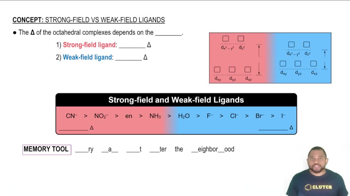
Ligand Field Theory explains how the presence of ligands around a central metal ion affects the energy levels of the d-orbitals. Strong field ligands cause a larger splitting of these d-orbitals, leading to greater stabilization of low-energy states. This theory is crucial for understanding the color and magnetic properties of coordination complexes.
Recommended video:
Guided course
Strong-Field Ligands result in a large Δ and Weak-Field Ligands result in a small Δ.
Crystal Field Splitting
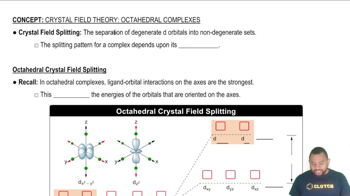
Crystal Field Splitting refers to the energy difference between the split d-orbitals in a transition metal complex due to the electrostatic interactions between the metal ion and surrounding ligands. The extent of this splitting is influenced by the nature of the ligands, with strong field ligands causing larger splits, which can affect the color observed in the complex.
Recommended video:
Guided course
The crystal field splitting pattern for octahedral complexes has the d orbitals on or along the axes as having the higher energy.
Field Strength of Ligands
The field strength of ligands is a measure of their ability to split the d-orbitals of a metal ion. Ligands are classified as strong or weak field based on their ability to cause this splitting. Nitro (-NO2) is generally considered a stronger field ligand than nitrito (-ONO), leading to greater d-orbital splitting and different electronic transitions, which can be observed as distinct colors in the complexes.
Recommended video:
Guided course
Strong-Field Ligands result in a large Δ and Weak-Field Ligands result in a small Δ.
Related Practice
Textbook Question
108
views
Textbook Question
Which of the following complexes are paramagnetic?
(a) [Mn(CN)6]3-
(b) [Zn(NH3)4]2+ (tetrahedral)
(c) [Fe(CN)6]4-
(d) [FeF6]4-
101
views
Textbook Question
Draw the structure of all isomers of the octahedral complex [NbX2Cl4]- (X- = NCS-), and identify those that are linkage isomers.
99
views
Textbook Question
For each of the following complexes, draw a crystal field energy-level diagram, assign the electrons to orbitals, and predict the number of unpaired electrons.
(a) [CrF6]3-
(b) [V(H2O)6]3+
(c) [Fe(CN)6]3-
96
views
Textbook Question
What is the systematic name for each of the following coordination compounds?
(c) [Co(NH3)4Br2]Br
(d) Cu(gly)2
170
views
Textbook Question
Classify the following ligands as monodentate, bidentate, tri-dentate, or tetradentate. Which can form chelate rings?
(a)
(b)
(c)
(d)
108
views