Pearson+ LogoPearson+ Logo
Ch. 7 - DNA Structure and Replication
Sanders - Genetic Analysis: An Integrated Approach 3rd Edition
Sanders3rd EditionGenetic Analysis: An Integrated ApproachISBN: 9780135564172Not the one you use?Change textbook
Chapter 7, Problem 5d

One strand of a fragment of duplex DNA has the sequence 5'-ATCGACCTGATC-3'.
Which chemical groups of nucleotides react to form the bond in part (b)?

Verified step by step guidance
1
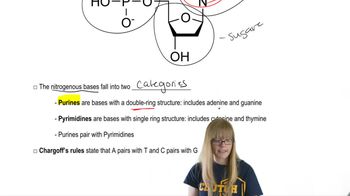
Identify the structure of a nucleotide, which consists of three components: a phosphate group, a sugar (deoxyribose in DNA), and a nitrogenous base.
Understand that the bond in question is the phosphodiester bond, which links nucleotides together in the DNA backbone.
Recognize that the phosphodiester bond forms between the 3'-hydroxyl (-OH) group of the sugar in one nucleotide and the 5'-phosphate group of the sugar in the adjacent nucleotide.
Visualize the reaction: the 3'-OH group of one nucleotide attacks the phosphate group of the incoming nucleotide, resulting in the release of a water molecule (condensation reaction).
Conclude that the chemical groups involved in forming the bond are the 3'-hydroxyl group of one nucleotide and the 5'-phosphate group of the next nucleotide.

Verified video answer for a similar problem:

This video solution was recommended by our tutors as helpful for the problem above.
Video duration:
3m
Was this helpful?

Key Concepts

Here are the essential concepts you must grasp in order to answer the question correctly.

Nucleotide Structure

Nucleotides, the building blocks of DNA, consist of a phosphate group, a sugar (deoxyribose in DNA), and a nitrogenous base (adenine, thymine, cytosine, or guanine). The arrangement of these components is crucial for understanding how nucleotides link together to form DNA strands.
Recommended video:
Guided course
06:25
DNA Structure

Phosphodiester Bond

Phosphodiester bonds are the covalent linkages that connect the 5' phosphate group of one nucleotide to the 3' hydroxyl group of another. This bond forms the backbone of the DNA strand, allowing for the stability and integrity of the genetic material.
Recommended video:
Guided course
06:25
DNA Structure

DNA Strand Orientation

DNA strands have directionality, indicated as 5' to 3'. This orientation is essential for understanding how nucleotides are added during DNA replication and transcription, as well as how the strands pair through complementary base pairing, which is vital for the structure of the double helix.
Recommended video:
Guided course
03:03
Double Strand Breaks