Compare and contrast the following terms: Homozygous and Heterozygous
Verified step by step guidance
1
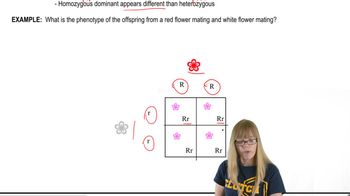
Define the term 'homozygous': An organism is homozygous for a gene when it has two identical alleles for that gene. For example, if the gene for flower color has alleles 'A' (dominant) and 'a' (recessive), a homozygous individual could have the genotype AA or aa.
Define the term 'heterozygous': An organism is heterozygous for a gene when it has two different alleles for that gene. Using the same example, a heterozygous individual would have the genotype Aa.
Explain the functional difference: In a homozygous individual, the trait expressed is determined solely by the identical alleles present. In a heterozygous individual, the dominant allele typically masks the effect of the recessive allele, leading to the expression of the dominant trait.
Discuss inheritance patterns: Homozygous individuals can only pass on one type of allele to their offspring (e.g., A or a), while heterozygous individuals can pass on either allele (A or a) with equal probability.
Summarize the comparison: Homozygous refers to having identical alleles for a gene, while heterozygous refers to having different alleles. This distinction is important in understanding inheritance patterns, phenotypic expression, and genetic diversity.
Verified video answer for a similar problem:
This video solution was recommended by our tutors as helpful for the problem above
Video duration:
1m
Play a video:
Was this helpful?
Key Concepts
Here are the essential concepts you must grasp in order to answer the question correctly.
Homozygous
Homozygous refers to a genetic condition where an individual has two identical alleles for a specific gene. This means that both inherited copies of the gene, one from each parent, are the same, which can be either dominant or recessive. For example, an individual with two alleles for blue eyes (bb) is homozygous for that trait.
Heterozygous describes a genetic scenario where an individual possesses two different alleles for a particular gene. This means that one allele is inherited from one parent and a different allele from the other. For instance, an individual with one allele for brown eyes (B) and one for blue eyes (b) is heterozygous for eye color.
Genetic variation refers to the diversity in gene frequencies within a population. It is crucial for evolution and adaptation, as it provides the raw material for natural selection. The presence of homozygous and heterozygous individuals contributes to this variation, influencing traits and the overall genetic makeup of a population.