Which of the follow sex chromosomes can be describes as homogametic?
Table of contents
- 1. Introduction to Genetics51m
- 2. Mendel's Laws of Inheritance3h 37m
- 3. Extensions to Mendelian Inheritance2h 41m
- 4. Genetic Mapping and Linkage2h 28m
- 5. Genetics of Bacteria and Viruses1h 21m
- 6. Chromosomal Variation1h 48m
- 7. DNA and Chromosome Structure56m
- 8. DNA Replication1h 10m
- 9. Mitosis and Meiosis1h 34m
- 10. Transcription1h 0m
- 11. Translation58m
- 12. Gene Regulation in Prokaryotes1h 19m
- 13. Gene Regulation in Eukaryotes44m
- 14. Genetic Control of Development44m
- 15. Genomes and Genomics1h 50m
- 16. Transposable Elements47m
- 17. Mutation, Repair, and Recombination1h 6m
- 18. Molecular Genetic Tools19m
- 19. Cancer Genetics29m
- 20. Quantitative Genetics1h 26m
- 21. Population Genetics50m
- 22. Evolutionary Genetics29m
3. Extensions to Mendelian Inheritance
Sex Chromosome
Problem 1d
Textbook Question
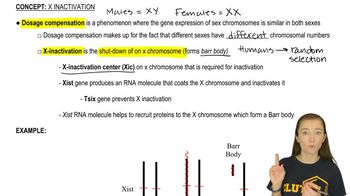
How do we know that X chromosomal inactivation of either the paternal or maternal homolog is a random event during early development in mammalian females?
Verified step by step guidance1
Understand the biological context: In female mammals, one of the two X chromosomes (either maternal or paternal) is inactivated in each cell to achieve dosage compensation. This process is called X chromosomal inactivation (XCI).
Recognize that if XCI were not random, but instead always inactivated the same parental X chromosome, all cells would show the same pattern of active and inactive X chromosomes.
Examine experimental evidence from studies using female mammals heterozygous for X-linked genetic markers or mutations. These studies show a mosaic pattern where some cells express genes from the maternal X and others from the paternal X.
Understand that this mosaicism indicates that inactivation occurs independently and randomly in each cell early in development, rather than being predetermined or imprinted.
Review molecular techniques such as DNA methylation analysis or RNA FISH that demonstrate random inactivation patterns across different tissues, further supporting the conclusion that XCI is a random event.
Verified video answer for a similar problem:This video solution was recommended by our tutors as helpful for the problem above
Video duration:
1mPlay a video:
Was this helpful?
Key Concepts
Here are the essential concepts you must grasp in order to answer the question correctly.
X Chromosomal Inactivation
X chromosomal inactivation is a process in female mammals where one of the two X chromosomes is silenced to balance gene expression with males. This inactivation occurs early in development and results in cells expressing genes from only one X chromosome, either maternal or paternal.
Recommended video:
Guided course
X-Inactivation
Randomness of X Inactivation
The randomness of X inactivation means that in each cell, either the maternal or paternal X chromosome is inactivated without a predetermined pattern. This leads to a mosaic of cells expressing genes from different X chromosomes, which can be observed through genetic or phenotypic markers.
Recommended video:
Guided course
X-Inactivation
Evidence from Mosaicism and Genetic Markers
Mosaicism in female mammals, such as calico coat patterns in cats, provides evidence for random X inactivation. Genetic studies using polymorphic markers show that different cells inactivate different X chromosomes, confirming the randomness during early embryonic development.
Recommended video:
Guided course
Mapping with Markers
Related Videos
Related Practice
Multiple Choice
676
views
6
rank