
Textbook Question
Why do loss-of-function mutations in Hox genes usually result in embryo lethality, whereas gain-of-function mutants can be viable? Why are flies homozygous for the recessive loss-of-function alleles and viable?
497
views

 Verified step by step guidance
 03:51
03:51
 11:19
11:19 03:38
03:38Why do loss-of-function mutations in Hox genes usually result in embryo lethality, whereas gain-of-function mutants can be viable? Why are flies homozygous for the recessive loss-of-function alleles and viable?
What is the difference between a parasegment and a segment in Drosophila development? Why do developmental biologists think of parasegments as the subdivisions that are produced during the development of flies?
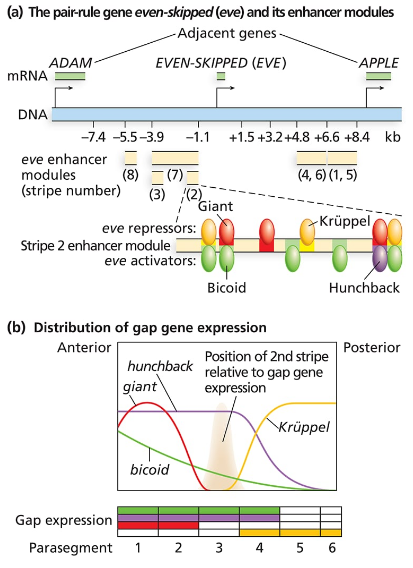
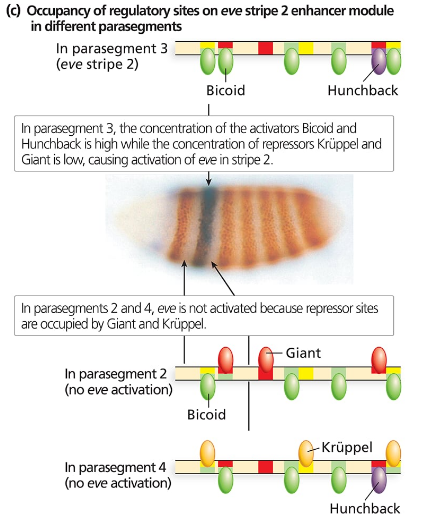
Consider the even-skipped regulatory sequences in the following figure:
How are the sharp boundaries of expression of Eve Stripe 2 formed?
Compare and contrast the specification of segmental identity in Drosophila with that of floral organ specification in Arabidopsis. What is the same in this process, and what is different?
Early development in Drosophila is atypical in that pattern formation takes place in a syncytial blastoderm, allowing free diffusion of transcription factors between nuclei. In many other animal species, the fertilized egg is divided by cellular cleavages into a larger and larger number of smaller and smaller cells.
How must the model that describes Drosophila development be modified for describing animal species whose early development is not syncytial?
Consider the even-skipped regulatory sequences in Figure 18.9.
Consider the binding sites for gap proteins and Bicoid in the stripe 2 enhancer module. What sites are occupied in parasegments 2, 3, and 4, and how does this result in expression or no expression?