Pearson+ LogoPearson+ Logo
Ch. 18 - Developmental Genetics
Sanders - Genetic Analysis: An Integrated Approach 3rd Edition
Sanders3rd EditionGenetic Analysis: An Integrated ApproachISBN: 9780135564172Not the one you use?Change textbook
Chapter 18, Problem 5b

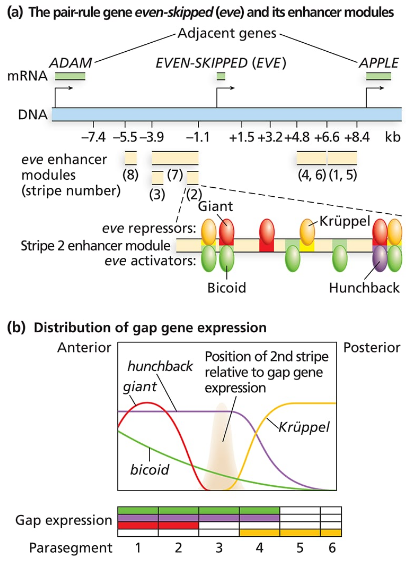
Consider the even-skipped regulatory sequences in Figure 18.9.
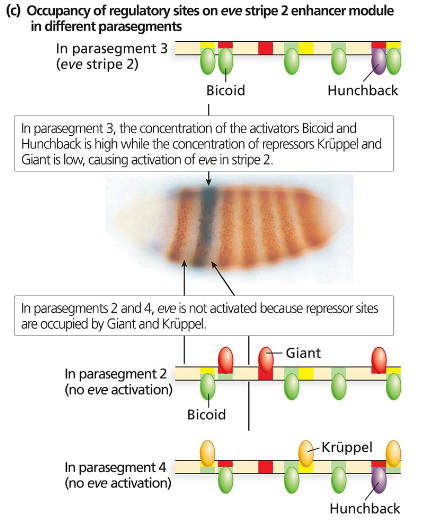
Consider the binding sites for gap proteins and Bicoid in the stripe 2 enhancer module. What sites are occupied in parasegments 2, 3, and 4, and how does this result in expression or no expression?
Diagram showing even-skipped gene enhancers with binding sites for repressors and activators and gap gene expression across parasegments.Diagram showing binding of activators Bicoid and Hunchback in parasegment 3 activates eve stripe 2; repressors Giant and Krüppel bind in 2 and 4, blocking expression.

Verified step by step guidance
1
Step 1: Understand the biological context—'even-skipped' (eve) is a segmentation gene in Drosophila, and its stripe 2 enhancer module controls expression in specific parasegments by integrating inputs from gap proteins and Bicoid, which are transcription factors that bind to regulatory DNA sequences.
Step 2: Identify the binding sites for gap proteins (such as Hunchback, Kruppel, Giant) and Bicoid within the stripe 2 enhancer module, noting which proteins act as activators and which act as repressors for eve expression.
Step 3: For each parasegment (2, 3, and 4), determine the presence or absence of these proteins based on their expression gradients and domains, then infer which binding sites are occupied by activators or repressors in that parasegment.
Step 4: Analyze how the combination of occupied activator and repressor sites in each parasegment influences the transcriptional activity of the stripe 2 enhancer—activator binding promotes expression, while repressor binding inhibits it.
Step 5: Conclude for each parasegment whether eve stripe 2 is expressed or not, based on the net effect of bound proteins at the enhancer, explaining how the spatial pattern of protein binding leads to the observed stripe pattern.

Verified video answer for a similar problem:

This video solution was recommended by our tutors as helpful for the problem above.
Video duration:
2m
Was this helpful?

Key Concepts

Here are the essential concepts you must grasp in order to answer the question correctly.

Even-skipped (eve) Stripe 2 Enhancer Module

The even-skipped gene contains specific regulatory DNA sequences called enhancers that control its expression in distinct stripes during embryonic development. The stripe 2 enhancer integrates inputs from various transcription factors to activate eve expression precisely in parasegment 2. Understanding this module is key to linking protein binding patterns to spatial gene expression.
Recommended video:
Guided course
09:16
Eukaryotic Transcription

Gap Proteins and Bicoid as Transcriptional Regulators

Gap proteins (such as Kruppel and Giant) and Bicoid are maternal and zygotic transcription factors that bind to specific sites on enhancers. Bicoid generally acts as an activator, while gap proteins can act as activators or repressors depending on context. Their binding patterns in different parasegments determine whether the target gene is expressed or repressed.
Recommended video:

Spatial Regulation of Gene Expression in Parasegments

Parasegments are embryonic units with distinct gene expression profiles. The combination of transcription factors bound to the stripe 2 enhancer varies across parasegments 2, 3, and 4, leading to differential gene expression. This spatial regulation ensures that even-skipped is expressed only where activators dominate and repressors are absent or minimal.
Recommended video:
Guided course
02:09
Penetrance and Expressivity
Related Practice
Textbook Question

Early development in Drosophila is atypical in that pattern formation takes place in a syncytial blastoderm, allowing free diffusion of transcription factors between nuclei. In many other animal species, the fertilized egg is divided by cellular cleavages into a larger and larger number of smaller and smaller cells.

What constraints does the formation of a syncytial blastoderm impose on the mechanisms of pattern formation?

406
views
Textbook Question

Early development in Drosophila is atypical in that pattern formation takes place in a syncytial blastoderm, allowing free diffusion of transcription factors between nuclei. In many other animal species, the fertilized egg is divided by cellular cleavages into a larger and larger number of smaller and smaller cells.

How must the model that describes Drosophila development be modified for describing animal species whose early development is not syncytial?

552
views
Textbook Question

Consider the even-skipped regulatory sequences in the following figure:

How are the sharp boundaries of expression of Eve Stripe 2 formed?

468
views
Textbook Question

Consider the even-skipped regulatory sequences in Figure 18.9.

Explain what you expect to see happen to even-skipped stripe 2 if it is expressed in a Krüppel mutant background. What about a hunchback mutant background? A giant mutant background? A bicoid mutant background?

694
views
Textbook Question

What is the difference between a parasegment and a segment in Drosophila development? Why do developmental biologists think of parasegments as the subdivisions that are produced during the development of flies?

1249
views
Textbook Question

Why do loss-of-function mutations in Hox genes usually result in embryo lethality, whereas gain-of-function mutants can be viable? Why are flies homozygous for the recessive loss-of-function alleles  and  viable?

495
views