Pearson+ LogoPearson+ Logo
Ch. 18 - Developmental Genetics
Sanders - Genetic Analysis: An Integrated Approach 3rd Edition
Sanders3rd EditionGenetic Analysis: An Integrated ApproachISBN: 9780135564172Not the one you use?Change textbook
Chapter 18, Problem 5a

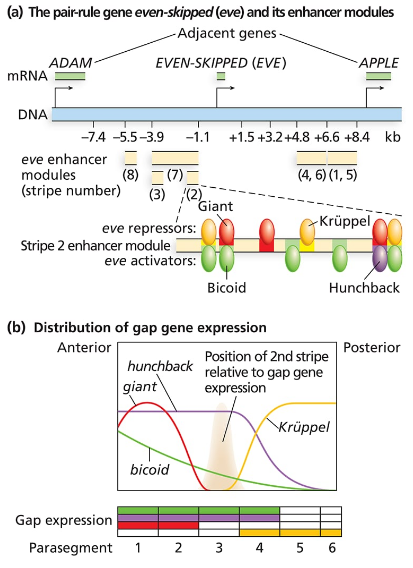
Consider the even-skipped regulatory sequences in the following figure:
How are the sharp boundaries of expression of Eve Stripe 2 formed?
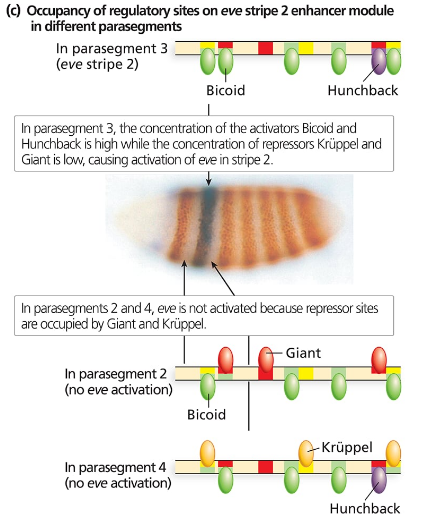
Diagram showing even-skipped gene enhancers, repressors, activators, and gap gene expression patterns forming Eve Stripe 2 boundaries.Diagram showing how activators Bicoid and Hunchback promote eve stripe 2 expression, while repressors Giant and Krüppel prevent expression in adjacent regions.

Verified step by step guidance
1
Understand that the even-skipped (Eve) gene is expressed in distinct stripes during Drosophila embryogenesis, and each stripe's sharp boundary is controlled by specific regulatory sequences.
Recognize that the sharp boundaries of Eve Stripe 2 expression are formed through the combined action of activator and repressor transcription factors binding to the stripe 2 enhancer region.
Identify the key activators such as Bicoid and Hunchback proteins that bind to the enhancer to promote expression in the central region of Stripe 2.
Note the role of repressors like Giant and Kruppel proteins, which bind to sites flanking the activator binding sites, restricting expression and creating sharp anterior and posterior boundaries.
Conclude that the interplay between these spatially distributed activators and repressors, through their binding to the regulatory sequences, results in the precise and sharp expression pattern of Eve Stripe 2.

Verified video answer for a similar problem:

This video solution was recommended by our tutors as helpful for the problem above.
Video duration:
3m
Was this helpful?

Key Concepts

Here are the essential concepts you must grasp in order to answer the question correctly.

Gene Regulatory Sequences

Gene regulatory sequences are DNA regions that control the timing, location, and level of gene expression. In the case of even-skipped (Eve), specific enhancers respond to transcription factors to activate or repress expression in precise spatial patterns, such as the formation of stripes in Drosophila embryos.
Recommended video:
Guided course
08:41
Sequencing Difficulties

Transcription Factor Gradients and Combinatorial Control

Sharp expression boundaries arise from the combined effects of activator and repressor transcription factors distributed in gradients. For Eve Stripe 2, activators like Bicoid and Hunchback promote expression, while repressors like Giant and Kruppel inhibit it, creating a precise spatial pattern through their overlapping domains.
Recommended video:
Guided course
09:16
Eukaryotic Transcription

Enhancer-Mediated Spatial Patterning

Enhancers integrate multiple transcription factor inputs to generate distinct expression domains. The Eve Stripe 2 enhancer contains binding sites for both activators and repressors, enabling it to interpret positional information and produce a sharp, well-defined stripe of gene expression in the embryo.
Recommended video:
Guided course
11:19
Segmentation Genes
Related Practice
Textbook Question

How is positional information provided along the anterior–posterior axis in Drosophila? What are the functions of bicoid and nanos?

511
views
Textbook Question

Early development in Drosophila is atypical in that pattern formation takes place in a syncytial blastoderm, allowing free diffusion of transcription factors between nuclei. In many other animal species, the fertilized egg is divided by cellular cleavages into a larger and larger number of smaller and smaller cells.

What constraints does the formation of a syncytial blastoderm impose on the mechanisms of pattern formation?

406
views
Textbook Question

Early development in Drosophila is atypical in that pattern formation takes place in a syncytial blastoderm, allowing free diffusion of transcription factors between nuclei. In many other animal species, the fertilized egg is divided by cellular cleavages into a larger and larger number of smaller and smaller cells.

How must the model that describes Drosophila development be modified for describing animal species whose early development is not syncytial?

552
views
Textbook Question

Consider the even-skipped regulatory sequences in Figure 18.9.

Consider the binding sites for gap proteins and Bicoid in the stripe 2 enhancer module. What sites are occupied in parasegments 2, 3, and 4, and how does this result in expression or no expression?

553
views
Textbook Question

Consider the even-skipped regulatory sequences in Figure 18.9.

Explain what you expect to see happen to even-skipped stripe 2 if it is expressed in a Krüppel mutant background. What about a hunchback mutant background? A giant mutant background? A bicoid mutant background?

694
views
Textbook Question

What is the difference between a parasegment and a segment in Drosophila development? Why do developmental biologists think of parasegments as the subdivisions that are produced during the development of flies?

1249
views