Pearson+ LogoPearson+ Logo
Ch. 18 - Developmental Genetics
Sanders - Genetic Analysis: An Integrated Approach 3rd Edition
Sanders3rd EditionGenetic Analysis: An Integrated ApproachISBN: 9780135564172Not the one you use?Change textbook
Chapter 18, Problem 7

Why do loss-of-function mutations in Hox genes usually result in embryo lethality, whereas gain-of-function mutants can be viable? Why are flies homozygous for the recessive loss-of-function alleles  and  viable?

Verified step by step guidance
1
Understand the role of Hox genes: Hox genes are crucial for the proper development of body plans in embryos. They determine the identity of segments along the anterior-posterior axis.
Loss-of-function mutations: These mutations result in the loss of normal function of the Hox genes, leading to incorrect segment identity and often embryo lethality due to critical developmental errors.
Gain-of-function mutations: These mutations can cause Hox genes to be expressed in new locations or at different times, potentially leading to viable organisms if the changes do not disrupt essential developmental processes.
Consider the genetic background: In some organisms, like flies, the presence of other compensatory genetic mechanisms or redundant pathways can allow for viability even with loss-of-function mutations.
Homozygous recessive viability: In flies, being homozygous for recessive loss-of-function alleles might still allow viability if other genes or pathways can compensate for the loss, or if the affected Hox gene is not critical for survival.

Verified video answer for a similar problem:

This video solution was recommended by our tutors as helpful for the problem above.
Video duration:
2m
Was this helpful?

Key Concepts

Here are the essential concepts you must grasp in order to answer the question correctly.

Hox Genes

Hox genes are a group of related genes that determine the body plan and the identity of segments in an embryo. They play a crucial role in the development of the anterior-posterior axis and are responsible for the proper formation of structures such as limbs and organs. Mutations in these genes can lead to significant developmental abnormalities, often resulting in embryo lethality.
Recommended video:
Guided course
02:34
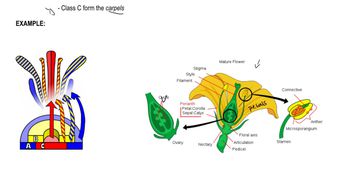
Plant HOX genes

Loss-of-Function vs. Gain-of-Function Mutations

Loss-of-function mutations result in the complete or partial inactivation of a gene, which can disrupt essential developmental processes, leading to embryo lethality. In contrast, gain-of-function mutations enhance or alter the gene's activity, which may not be detrimental and can sometimes even confer advantageous traits, allowing the organism to survive and develop normally.
Recommended video:
Guided course
08:26
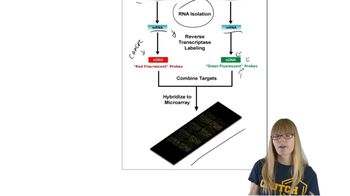
Functional Genomics

Recessive Alleles and Homozygosity

Recessive alleles require two copies to express a phenotype, meaning that flies homozygous for recessive loss-of-function alleles may still be viable if they possess a functional copy of the gene from another source or if the specific loss-of-function mutation does not completely eliminate the gene's activity. This can allow for normal development despite the presence of mutations.
Recommended video:
Guided course
03:03
New Alleles and Migration
Related Practice
Textbook Question

Consider the even-skipped regulatory sequences in Figure 18.9.

Consider the binding sites for gap proteins and Bicoid in the stripe 2 enhancer module. What sites are occupied in parasegments 2, 3, and 4, and how does this result in expression or no expression?

553
views
Textbook Question

Consider the even-skipped regulatory sequences in Figure 18.9.

Explain what you expect to see happen to even-skipped stripe 2 if it is expressed in a Krüppel mutant background. What about a hunchback mutant background? A giant mutant background? A bicoid mutant background?

694
views
Textbook Question

What is the difference between a parasegment and a segment in Drosophila development? Why do developmental biologists think of parasegments as the subdivisions that are produced during the development of flies?

1249
views
Textbook Question

Compare and contrast the specification of segmental identity in Drosophila with that of floral organ specification in Arabidopsis. What is the same in this process, and what is different?

558
views
Textbook Question

Actinomycin D is a drug that inhibits the activity of RNA polymerase II. In the presence of actinomycin D, early development in many vertebrate species, such as frogs, can proceed past the formation of a blastula, a hollow ball of cells that forms after early cleavage divisions, but development ceases before gastrulation (the stage at which cell layers are established). What does this tell you about maternal versus zygotic gene activity in early frog development?

536
views
Textbook Question

Ablation of the anchor cell in wild-type C. elegans results in a vulva-less phenotype.

What phenotype is to be expected if the anchor cell is ablated in a let-23 loss-of-function mutant?

443
views