Suppose that base substitution mutations sufficient to eliminate the function of the operator regions listed below were to occur. For each case, describe how transcription or life cycle would be affected. lacO mutation in E. coli
Verified step by step guidance
1
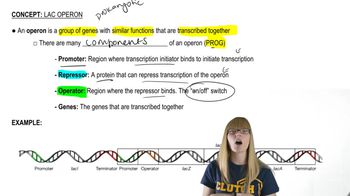
Understand the role of the lacO (operator) region in the lac operon of E. coli. The lacO region is the binding site for the lac repressor protein, which regulates transcription of the lac operon genes.
Recognize that a mutation in the lacO region could prevent the lac repressor from binding to the operator. This would disrupt the normal regulation of the operon.
Consider the consequences of the lac repressor being unable to bind. Without repression, the lac operon would be constitutively expressed, meaning the genes for lactose metabolism (lacZ, lacY, and lacA) would be transcribed continuously, regardless of the presence or absence of lactose.
Relate this to the life cycle of E. coli. Continuous expression of the lac operon could waste cellular resources when lactose is not present, potentially reducing the efficiency of the cell's metabolism.
Conclude that the mutation in the lacO region would lead to a loss of regulatory control over the lac operon, resulting in unregulated transcription of the operon genes and potential metabolic inefficiency for the organism.
Verified video answer for a similar problem:
This video solution was recommended by our tutors as helpful for the problem above
Video duration:
3m
Play a video:
Was this helpful?
Key Concepts
Here are the essential concepts you must grasp in order to answer the question correctly.
Operator Regions
Operator regions are specific DNA sequences where regulatory proteins bind to control the transcription of adjacent genes. In prokaryotes like E. coli, the operator is part of operons, which are clusters of genes transcribed together. Mutations in these regions can disrupt the binding of repressor proteins, leading to either constitutive expression or silencing of the genes involved.
The lac operon is a well-studied example of gene regulation in E. coli, responsible for the metabolism of lactose. It consists of three structural genes (lacZ, lacY, and lacA) and is regulated by the lac repressor, which binds to the operator region (lacO) to inhibit transcription in the absence of lactose. A mutation in lacO can prevent the repressor from binding, resulting in uncontrolled expression of the operon.
Transcription regulation refers to the mechanisms that control the rate of gene expression by influencing the transcription of specific genes. In bacteria, this often involves the interaction of transcription factors with operator regions. Disruption of these interactions, such as through mutations, can lead to either overexpression or complete silencing of genes, significantly impacting cellular functions and responses to environmental changes.