Pearson+ LogoPearson+ Logo
Ch. 12 - Regulation of Gene Expression in Bacteria and Bacteriophage
Sanders - Genetic Analysis: An Integrated Approach 3rd Edition
Sanders3rd EditionGenetic Analysis: An Integrated ApproachISBN: 9780135564172Not the one you use?Change textbook
Chapter 12, Problem 27

Two different mutations affect PRE. Mutant 1 decreases transcription from the promoter to 10% of normal. Mutant 2 increases transcription from the promoter to 10 times greater than the wild type. How will each mutation affect the determination of the lytic or lysogenic life cycle in mutant λ phage strains? Explain your answers.

Verified step by step guidance
1
Understand the biological context: The λ phage can enter either the lytic or lysogenic life cycle. The decision is influenced by the levels of transcription of key genes, such as those encoding the CI repressor (favoring lysogeny) and Cro protein (favoring lysis). Transcription levels from the promoter are critical in determining which pathway is chosen.
Analyze the effect of Mutant 1: Mutant 1 decreases transcription from the promoter to 10% of normal. This means that the production of proteins encoded by this promoter will be significantly reduced. Consider how reduced transcription affects the balance between CI and Cro proteins, and whether it shifts the decision toward the lytic or lysogenic pathway.
Analyze the effect of Mutant 2: Mutant 2 increases transcription from the promoter to 10 times greater than the wild type. This results in a dramatic increase in the production of proteins encoded by this promoter. Evaluate how this overexpression impacts the balance between CI and Cro proteins, and whether it favors the lytic or lysogenic pathway.
Compare the two mutations: Contrast the effects of reduced transcription (Mutant 1) and increased transcription (Mutant 2) on the λ phage life cycle. Discuss how each mutation disrupts the normal regulatory mechanisms that control the decision between lysis and lysogeny.
Summarize the outcomes: Conclude how each mutation affects the determination of the lytic or lysogenic life cycle. Highlight the importance of precise transcriptional regulation in maintaining the balance between these two pathways in λ phage strains.

Verified video answer for a similar problem:

This video solution was recommended by our tutors as helpful for the problem above.
Video duration:
3m
Was this helpful?

Key Concepts

Here are the essential concepts you must grasp in order to answer the question correctly.

Transcription Regulation

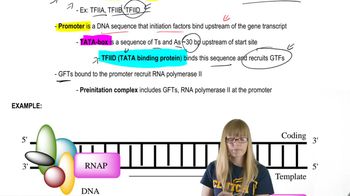
Transcription regulation refers to the mechanisms that control the rate of gene expression by influencing the transcription of specific genes. In the context of phage λ, the ability of the promoter to initiate transcription is crucial for determining whether the phage enters a lytic or lysogenic cycle. Mutations that alter transcription levels can significantly impact the expression of genes responsible for these life cycles.
Recommended video:
Guided course
09:16
Eukaryotic Transcription

Lytic vs. Lysogenic Cycle

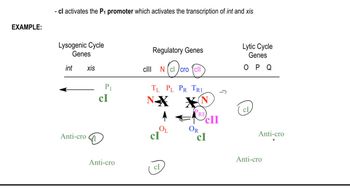
The lytic cycle is a viral reproductive process that results in the destruction of the host cell, while the lysogenic cycle allows the virus to integrate its genetic material into the host genome, remaining dormant. The decision between these two pathways is influenced by environmental conditions and the expression of specific genes, such as those controlled by the promoter affected by the mutations in the question.
Recommended video:
Guided course
08:04
Decision Between Lytic and Lysogenic Cycles

Mutations and Their Effects

Mutations are changes in the DNA sequence that can affect gene function and expression. In this scenario, Mutant 1 reduces transcription significantly, likely leading to a preference for the lysogenic cycle due to insufficient gene expression for lytic functions. Conversely, Mutant 2's increased transcription may push the phage towards the lytic cycle, as more lytic genes are expressed, promoting viral replication and cell lysis.
Recommended video:
Guided course
03:38
Maternal Effect