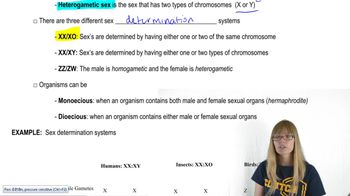
In the ZZ/ZW sex determination system, the male is…?
Table of contents
- 1. Introduction to Genetics51m
- 2. Mendel's Laws of Inheritance3h 37m
- 3. Extensions to Mendelian Inheritance2h 41m
- 4. Genetic Mapping and Linkage2h 28m
- 5. Genetics of Bacteria and Viruses1h 21m
- 6. Chromosomal Variation1h 48m
- 7. DNA and Chromosome Structure56m
- 8. DNA Replication1h 10m
- 9. Mitosis and Meiosis1h 34m
- 10. Transcription1h 0m
- 11. Translation58m
- 12. Gene Regulation in Prokaryotes1h 19m
- 13. Gene Regulation in Eukaryotes44m
- 14. Genetic Control of Development44m
- 15. Genomes and Genomics1h 50m
- 16. Transposable Elements47m
- 17. Mutation, Repair, and Recombination1h 6m
- 18. Molecular Genetic Tools19m
- 19. Cancer Genetics29m
- 20. Quantitative Genetics1h 26m
- 21. Population Genetics50m
- 22. Evolutionary Genetics29m
3. Extensions to Mendelian Inheritance
Sex Chromosome
Problem 1c
Textbook Question
How do we know that Drosophila utilizes a different sex-determination mechanism than mammals, even though it has the same sex-chromosome compositions in males and females?
Verified step by step guidance1
Step 1: Understand the sex chromosome compositions in both mammals and Drosophila. In mammals, females are XX and males are XY, while in Drosophila, females are also XX and males are XY.
Step 2: Recognize that despite having the same chromosomal notation (XX for females and XY for males), the mechanism that determines sex differs between the two organisms.
Step 3: Learn that in mammals, the presence of the Y chromosome, specifically the SRY gene on the Y chromosome, triggers male development, making the Y chromosome the key determinant of sex.
Step 4: In contrast, Drosophila determines sex based on the ratio of X chromosomes to sets of autosomes (the X:A ratio), not simply the presence or absence of the Y chromosome. The Y chromosome in Drosophila is not the primary sex determinant but is required for male fertility.
Step 5: Conclude that the difference in sex-determination mechanisms is evident because mammals rely on a dominant Y-linked gene, whereas Drosophila relies on the X:A ratio, demonstrating that identical sex chromosome compositions can lead to different sex-determination systems.
Verified video answer for a similar problem:This video solution was recommended by our tutors as helpful for the problem above
Video duration:
4mPlay a video:
Was this helpful?
Key Concepts
Here are the essential concepts you must grasp in order to answer the question correctly.
Sex-Determination Mechanisms
Sex-determination mechanisms are biological systems that dictate an organism's sex. While mammals use the presence of the Y chromosome (XY males, XX females) to determine sex, Drosophila relies on the ratio of X chromosomes to sets of autosomes, not just the presence of a Y chromosome.
Recommended video:
Guided course
Sex Determination
Chromosomal Composition in Drosophila vs. Mammals
Both Drosophila and mammals have XY males and XX females, but in Drosophila, the Y chromosome is not the primary determinant of maleness. Instead, the X:A ratio (number of X chromosomes to autosome sets) controls sex, whereas in mammals, the Y chromosome carries the SRY gene that triggers male development.
Recommended video:
Guided course
Human Sex Chromosomes
Genetic and Molecular Evidence for Sex Determination
Experimental studies, such as chromosome manipulation and gene expression analysis, show that altering the X:A ratio in Drosophila changes sex phenotype regardless of Y presence. In contrast, mammals require the SRY gene on the Y chromosome for male development, demonstrating distinct molecular pathways despite similar chromosome types.
Recommended video:
Guided course
Sex Determination
Related Videos
Related Practice
Multiple Choice
857
views
3
rank