Pearson+ LogoPearson+ Logo
Ch. 7 - Sex Determination and Sex Chromosomes
Klug - Concepts of Genetics  12th Edition
Klug12th EditionConcepts of Genetics ISBN: 9780135564776Not the one you use?Change textbook
Chapter 7, Problem 1d

How do we know that X chromosomal inactivation of either the paternal or maternal homolog is a random event during early development in mammalian females?

Verified step by step guidance
1
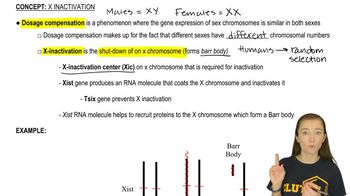
Understand the biological context: In female mammals, one of the two X chromosomes (either maternal or paternal) is inactivated in each cell to achieve dosage compensation. This process is called X chromosomal inactivation (XCI).
Recognize that if XCI were not random, but instead always inactivated the same parental X chromosome, all cells would show the same pattern of active and inactive X chromosomes.
Examine experimental evidence from studies using female mammals heterozygous for X-linked genetic markers or mutations. These studies show a mosaic pattern where some cells express genes from the maternal X and others from the paternal X.
Understand that this mosaicism indicates that inactivation occurs independently and randomly in each cell early in development, rather than being predetermined or imprinted.
Review molecular techniques such as DNA methylation analysis or RNA FISH that demonstrate random inactivation patterns across different tissues, further supporting the conclusion that XCI is a random event.

Verified video answer for a similar problem:

This video solution was recommended by our tutors as helpful for the problem above.
Video duration:
1m
Was this helpful?

Key Concepts

Here are the essential concepts you must grasp in order to answer the question correctly.

X Chromosomal Inactivation

X chromosomal inactivation is a process in female mammals where one of the two X chromosomes is silenced to balance gene expression with males. This inactivation occurs early in development and results in cells expressing genes from only one X chromosome, either maternal or paternal.
Recommended video:
Guided course
09:30
X-Inactivation

Randomness of X Inactivation

The randomness of X inactivation means that in each cell, either the maternal or paternal X chromosome is inactivated without a predetermined pattern. This leads to a mosaic of cells expressing genes from different X chromosomes, which can be observed through genetic or phenotypic markers.
Recommended video:
Guided course
09:30
X-Inactivation

Evidence from Mosaicism and Genetic Markers

Mosaicism in female mammals, such as calico coat patterns in cats, provides evidence for random X inactivation. Genetic studies using polymorphic markers show that different cells inactivate different X chromosomes, confirming the randomness during early embryonic development.
Recommended video:
Guided course
07:11
Mapping with Markers