Conjugation between an Hfr cell and an F⁻ cell does not usually result in conversion of exconjugants to the donor state. Occasionally, however, the result of this conjugation is two Hfr cells. Explain how this occurs.
Verified step by step guidance
1
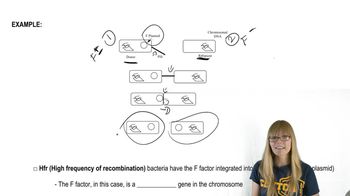
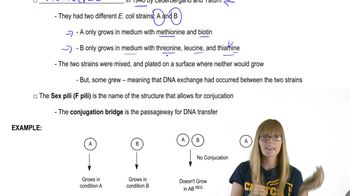
Understand the basics of bacterial conjugation: Conjugation is a process where genetic material is transferred from a donor cell (Hfr cell) to a recipient cell (F⁻ cell) through a physical connection called a pilus. The Hfr cell contains the F factor integrated into its chromosome, which facilitates the transfer of genetic material.
Recognize the typical outcome of Hfr and F⁻ conjugation: During conjugation, the Hfr cell transfers part of its chromosomal DNA to the F⁻ cell. However, the entire F factor is rarely transferred because the process is often interrupted before completion. As a result, the F⁻ cell does not become an Hfr cell in most cases.
Consider the rare scenario where the entire F factor is transferred: If the conjugation process is unusually prolonged or uninterrupted, the Hfr cell may successfully transfer the entire F factor along with a portion of its chromosomal DNA to the F⁻ cell. This would allow the F factor to integrate into the recipient's chromosome, converting the F⁻ cell into an Hfr cell.
Understand the mechanism of F factor integration: The F factor integrates into the recipient's chromosome through homologous recombination. This process requires specific sequences on the F factor and the bacterial chromosome to align and recombine, resulting in the formation of a new Hfr cell.
Conclude how two Hfr cells can result: In this rare event, the original Hfr cell remains unchanged, while the recipient F⁻ cell becomes an Hfr cell due to the successful transfer and integration of the F factor. This explains how conjugation can occasionally result in two Hfr cells.
Verified video answer for a similar problem:
This video solution was recommended by our tutors as helpful for the problem above
Video duration:
4m
Play a video:
Was this helpful?
Key Concepts
Here are the essential concepts you must grasp in order to answer the question correctly.
Hfr and F⁻ Cells
Hfr (high frequency of recombination) cells are bacterial cells that have integrated the F (fertility) plasmid into their chromosomal DNA, allowing them to transfer chromosomal genes during conjugation. F⁻ cells, on the other hand, lack the F plasmid and cannot initiate conjugation. Understanding the roles of these cell types is crucial for grasping the dynamics of genetic exchange in bacteria.
Conjugation is a form of horizontal gene transfer in bacteria where genetic material is transferred from a donor cell to a recipient cell through direct contact. In the case of Hfr and F⁻ cells, the Hfr cell can transfer part of its chromosomal DNA to the F⁻ cell. However, the transfer is often incomplete, which is why the F⁻ cell typically does not become an Hfr cell.
Recombination is the process by which genetic material is rearranged or exchanged between organisms, leading to genetic diversity. In the context of Hfr and F⁻ cell conjugation, if the transferred chromosomal DNA integrates into the recipient's genome, it can occasionally lead to the formation of a new Hfr cell if the F plasmid is also transferred. This rare event explains how two Hfr cells can arise from a single conjugation event.