Pearson+ LogoPearson+ Logo
Ch. 6 - Genetic Analysis and Mapping in Bacteria and Bacteriophages
Sanders - Genetic Analysis: An Integrated Approach 3rd Edition
Sanders3rd EditionGenetic Analysis: An Integrated ApproachISBN: 9780135564172Not the one you use?Change textbook
Chapter 6, Problem 1e

For bacteria that are F⁺, Hfr, F', and F⁻, perform or answer the following.
Describe the results of conjugation (i.e., changes in the recipient and the exconjugant) that allow detection of the state of the F factor in a donor strain.

Verified step by step guidance
1
Understand the F factor states: The F factor (fertility factor) is a plasmid that can exist in different states in bacteria. F⁺ bacteria have the F plasmid, Hfr bacteria have the F factor integrated into their chromosome, F' bacteria have the F plasmid with some chromosomal genes, and F⁻ bacteria lack the F factor.
Describe conjugation for F⁺ donors: When an F⁺ donor conjugates with an F⁻ recipient, the F plasmid is transferred to the recipient. The recipient becomes F⁺, and no chromosomal genes are transferred. This can be detected by the recipient gaining the ability to act as a donor in future conjugations.
Describe conjugation for Hfr donors: In Hfr conjugation, the F factor is integrated into the donor's chromosome. During conjugation, part of the donor's chromosomal DNA is transferred to the recipient. The recipient remains F⁻ but may acquire new chromosomal genes, which can be detected by changes in phenotype or genotype.
Describe conjugation for F' donors: In F' conjugation, the F plasmid carries some chromosomal genes. When the F' donor conjugates with an F⁻ recipient, the F' plasmid (including the chromosomal genes) is transferred. The recipient becomes F' and gains the donor's chromosomal genes, which can be detected by the expression of those genes.
Summarize detection methods: To detect the state of the F factor in the donor strain, observe the recipient's changes after conjugation. For F⁺ donors, the recipient becomes F⁺. For Hfr donors, the recipient remains F⁻ but may acquire new chromosomal traits. For F' donors, the recipient becomes F' and expresses the donor's chromosomal genes. These changes can be confirmed through genetic or phenotypic analysis.

Verified video answer for a similar problem:

This video solution was recommended by our tutors as helpful for the problem above.
Video duration:
1m
Was this helpful?

Key Concepts

Here are the essential concepts you must grasp in order to answer the question correctly.

Conjugation in Bacteria

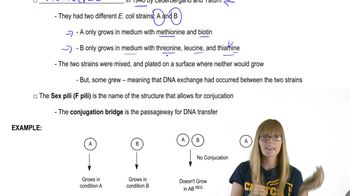
Conjugation is a process of genetic transfer in bacteria where one bacterium transfers genetic material to another through direct contact. This typically involves a donor cell with a fertility factor (F factor) forming a pilus to connect with a recipient cell. The F factor can exist in different states, influencing the genetic material transferred and the resulting changes in the recipient.
Recommended video:
Guided course
04:06
Conjugation Overview

F Factor States

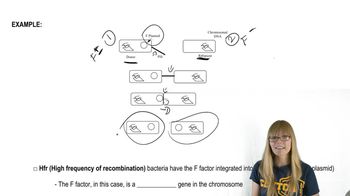
The F factor can exist in several states: F⁺ (fertility factor present), Hfr (high-frequency recombination, where the F factor is integrated into the chromosome), F' (a plasmid carrying some chromosomal genes), and F⁻ (no fertility factor). Each state affects the outcome of conjugation differently, particularly in terms of what genetic material is transferred to the recipient cell and whether it becomes F⁺ or remains F⁻.
Recommended video:
Guided course
08:52
F Factor and Hfr

Exconjugants and Recipient Changes

Exconjugants are the recipient cells that have undergone conjugation and received genetic material from the donor. Depending on the state of the F factor in the donor, the recipient can become F⁺ (if it receives the F factor) or acquire new traits (if chromosomal genes are transferred). The detection of these changes allows researchers to infer the state of the F factor in the donor strain based on the characteristics of the exconjugants.
Recommended video:
Guided course
03:03
New Alleles and Migration