Textbook Question
Explain the importance of the following features in conjugating donor bacteria:
homologous recombination
609
views

 Sanders 3rd EditionCh. 6 - Genetic Analysis and Mapping in Bacteria and BacteriophagesProblem 4
 Verified step by step guidance
 04:06
04:06
 05:53
05:53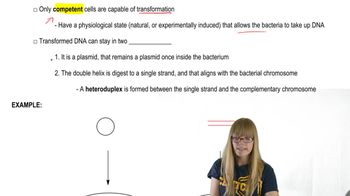 05:48
05:48Explain the importance of the following features in conjugating donor bacteria:
homologous recombination
Go online to the Online Mendelian Inheritance of Man (OMIM) website. Look up the following genetic conditions and answer the questions posed about them.
Go to the 'Population Genetics' section discussing the TSD gene. In a few sentences, summarize the human population in which TSD is most frequently found and give the approximate frequency of heterozygous carriers for the TSD mutation in North American Jews.
A couple comes into your genetic counseling practice with a question about the chance a future child of theirs might have a genetic disease. Three or four men in the woman's family, including her father, had a condition that might be genetic. Although her father is still alive, she has had little contact with him for much of her life and cannot describe or name the condition. Her partner is a healthy man whose family has no history indicating the presence of a genetic condition. To provide more information about this possible genetic condition for the couple, what is the first step you recommend?
Explain the importance of the following features in conjugating donor bacteria:
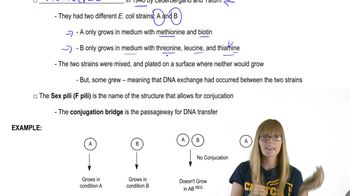
the conjugation pilus
Explain the importance of the following features in conjugating donor bacteria:
the origin of transfer
Conjugation between an Hfr cell and an F⁻ cell does not usually result in conversion of exconjugants to the donor state. Occasionally, however, the result of this conjugation is two Hfr cells. Explain how this occurs.