How do we know that specific genes are linked on a single chromosome, in contrast to being located on separate chromosomes?
Table of contents
- 1. Introduction to Genetics51m
- 2. Mendel's Laws of Inheritance3h 37m
- 3. Extensions to Mendelian Inheritance2h 41m
- 4. Genetic Mapping and Linkage2h 28m
- 5. Genetics of Bacteria and Viruses1h 21m
- 6. Chromosomal Variation1h 48m
- 7. DNA and Chromosome Structure56m
- 8. DNA Replication1h 10m
- 9. Mitosis and Meiosis1h 34m
- 10. Transcription1h 0m
- 11. Translation58m
- 12. Gene Regulation in Prokaryotes1h 19m
- 13. Gene Regulation in Eukaryotes44m
- 14. Genetic Control of Development44m
- 15. Genomes and Genomics1h 50m
- 16. Transposable Elements47m
- 17. Mutation, Repair, and Recombination1h 6m
- 18. Molecular Genetic Tools19m
- 19. Cancer Genetics29m
- 20. Quantitative Genetics1h 26m
- 21. Population Genetics50m
- 22. Evolutionary Genetics29m
4. Genetic Mapping and Linkage
Mapping Overview
Problem 3
Textbook Question
Describe the cytological observation that suggests that crossing over occurs during the first meiotic prophase.
Verified step by step guidance1
Understand that crossing over occurs during the first meiotic prophase, specifically in the pachytene stage, when homologous chromosomes are fully synapsed.
Recognize that cytological evidence for crossing over includes the visualization of chiasmata, which are the physical manifestations of crossover points between homologous chromosomes.
Note that during the diplotene stage of prophase I, homologous chromosomes begin to separate but remain connected at chiasmata, which can be observed under a microscope as X-shaped structures.
Identify that the presence of chiasmata indicates that genetic material has been exchanged between non-sister chromatids, confirming that crossing over has occurred.
Summarize that the key cytological observation suggesting crossing over is the appearance of chiasmata during the diplotene stage of the first meiotic prophase.
Verified video answer for a similar problem:This video solution was recommended by our tutors as helpful for the problem above
Video duration:
1mPlay a video:
Was this helpful?
Key Concepts
Here are the essential concepts you must grasp in order to answer the question correctly.
Meiosis and Its Stages
Meiosis is a specialized cell division that reduces chromosome number by half, producing gametes. It consists of two divisions: meiosis I and II. The first meiotic prophase is critical, involving chromosome pairing and recombination, setting the stage for genetic diversity.
Recommended video:
Guided course
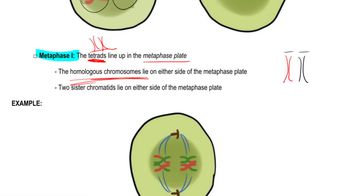
Meiosis Steps
Crossing Over and Chiasmata Formation
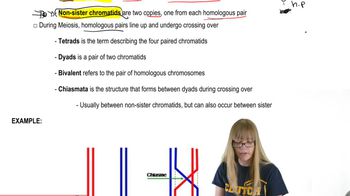
Crossing over is the exchange of genetic material between homologous chromosomes during prophase I. Cytologically, it is indicated by chiasmata, visible points where homologs remain connected after synapsis, reflecting sites of genetic recombination.
Recommended video:
Guided course
Crossing Over Terminology
Cytological Techniques for Observing Meiosis
Microscopic staining and chromosome spreading techniques allow visualization of chromosome behavior during meiosis. These methods reveal structures like synaptonemal complexes and chiasmata, providing direct evidence of crossing over during prophase I.
Recommended video:
Guided course
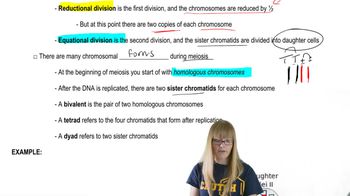
Meiosis Overview
Related Videos
Related Practice
Textbook Question
476
views