Which of the following gametes can be formed from the genotype AaBb if AB and ab are linked?
Table of contents
- 1. Introduction to Genetics51m
- 2. Mendel's Laws of Inheritance3h 37m
- 3. Extensions to Mendelian Inheritance2h 41m
- 4. Genetic Mapping and Linkage2h 28m
- 5. Genetics of Bacteria and Viruses1h 21m
- 6. Chromosomal Variation1h 48m
- 7. DNA and Chromosome Structure56m
- 8. DNA Replication1h 10m
- 9. Mitosis and Meiosis1h 34m
- 10. Transcription1h 0m
- 11. Translation58m
- 12. Gene Regulation in Prokaryotes1h 19m
- 13. Gene Regulation in Eukaryotes44m
- 14. Genetic Control of Development44m
- 15. Genomes and Genomics1h 50m
- 16. Transposable Elements47m
- 17. Mutation, Repair, and Recombination1h 6m
- 18. Molecular Genetic Tools19m
- 19. Cancer Genetics29m
- 20. Quantitative Genetics1h 26m
- 21. Population Genetics50m
- 22. Evolutionary Genetics29m
4. Genetic Mapping and Linkage
Crossing Over and Recombinants
Problem 4
Textbook Question
Why does more crossing over occur between two distantly linked genes than between two genes that are very close together on the same chromosome?
Verified step by step guidance1
Understand that crossing over occurs during meiosis when homologous chromosomes exchange segments, which increases genetic variation.
Recognize that the frequency of crossing over between two genes depends on the physical distance between them on the chromosome; the farther apart they are, the more likely a crossover event will occur between them.
Recall that genes that are very close together have less physical space between them, so the chance of a crossover happening between them is lower because the crossover event is a random process along the chromosome length.
Note that when genes are far apart, there is more chromosomal region where crossing over can occur, increasing the probability of at least one crossover event between those genes.
Conclude that the observed higher recombination frequency between distantly linked genes reflects the greater opportunity for crossover events due to their larger physical separation on the chromosome.
Verified video answer for a similar problem:This video solution was recommended by our tutors as helpful for the problem above
Video duration:
1mPlay a video:
Was this helpful?
Key Concepts
Here are the essential concepts you must grasp in order to answer the question correctly.
Genetic Linkage
Genetic linkage refers to the tendency of genes located close together on the same chromosome to be inherited together. Genes that are physically near each other have a lower chance of being separated by recombination during meiosis, resulting in fewer crossover events between them.
Recommended video:
Guided course
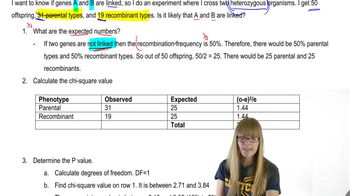
Chi Square and Linkage
Crossing Over and Recombination
Crossing over is the process where homologous chromosomes exchange segments during meiosis, creating new allele combinations. The frequency of crossing over between two genes depends on the physical distance between them; greater distance increases the likelihood of recombination.
Recommended video:
Guided course
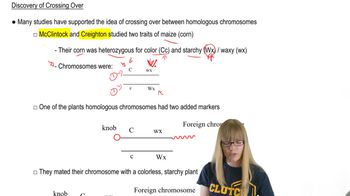
Discovery of Crossing Over
Recombination Frequency as a Measure of Distance
Recombination frequency quantifies how often crossing over occurs between two genes and is used to estimate their distance on a chromosome. Genes far apart have higher recombination frequencies because there is more physical space for crossover events to happen between them.
Recommended video:
Guided course
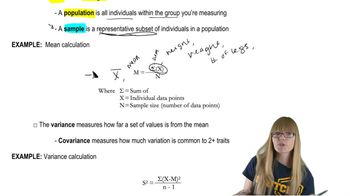
Mathematical Measurements
Related Videos
Related Practice
Multiple Choice
1160
views
4
rank