How was Mendel able to derive postulates concerning the behavior of 'unit factors' during gamete formation when he could not directly observe them?
Verified step by step guidance
1
Understand that Mendel's 'unit factors' refer to what we now call genes, which he could not see directly but inferred from patterns of inheritance.
Recognize that Mendel performed controlled breeding experiments with pea plants, tracking traits such as flower color and seed shape across generations.
Analyze the ratios of different traits in the offspring (F1 and F2 generations) to identify consistent patterns, such as the 3:1 ratio in the F2 generation for dominant and recessive traits.
From these observed ratios, deduce that traits are controlled by pairs of 'unit factors' (alleles), one inherited from each parent, which segregate during gamete formation.
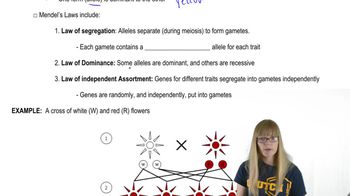
Formulate the postulates that (1) unit factors exist in pairs, (2) one unit factor can be dominant over the other, and (3) these unit factors segregate independently during gamete formation, explaining the observed inheritance patterns.
Verified video answer for a similar problem:
This video solution was recommended by our tutors as helpful for the problem above
Video duration:
4m
Play a video:
Was this helpful?
Key Concepts
Here are the essential concepts you must grasp in order to answer the question correctly.
Mendel's Experimental Approach
Mendel used controlled breeding experiments with pea plants to observe patterns of trait inheritance across generations. By analyzing the ratios of dominant and recessive traits in offspring, he inferred the existence and behavior of discrete hereditary units, despite not seeing them directly.
Mendel proposed that traits are controlled by 'unit factors' (now known as genes) that exist in pairs within an organism. These factors segregate independently during gamete formation, ensuring each gamete carries only one factor from each pair, explaining predictable inheritance patterns.
This postulate states that paired unit factors separate during gamete formation so that each gamete receives only one factor. Mendel deduced this law from the consistent 3:1 phenotypic ratios observed in monohybrid crosses, providing a foundation for understanding genetic inheritance.