Ch. 3 - Mendelian Genetics
Chapter 3, Problem 1c

In analyzing genetic data, how do we know whether deviation from the expected ratio is due to chance rather than to another, independent factor?

Verified step by step guidance
1
Understand that when analyzing genetic data, deviations from expected Mendelian ratios can occur due to random chance or due to other biological factors such as linkage, gene interaction, or environmental effects.
Use the Chi-square (\(\chi^{2}\)) test as a statistical method to determine whether the observed deviation from the expected ratio is likely due to chance.
Formulate the null hypothesis (\(H_0\)) that the observed data fits the expected Mendelian ratio, and the alternative hypothesis (\(H_a\)) that it does not.
Calculate the Chi-square statistic using the formula: \(\chi^{2} = \sum \frac{(O - E)^2}{E}\) where \(O\) is the observed frequency and \(E\) is the expected frequency for each category.
Compare the calculated \(\chi^{2}\) value to the critical value from the Chi-square distribution table at the appropriate degrees of freedom and significance level (commonly 0.05). If \(\chi^{2}\) is less than the critical value, the deviation is likely due to chance; if greater, it suggests other factors may be influencing the data.

Verified video answer for a similar problem:

This video solution was recommended by our tutors as helpful for the problem above.
Video duration:
1m
Was this helpful?

Key Concepts

Here are the essential concepts you must grasp in order to answer the question correctly.

Mendelian Postulates

Mendelian postulates are the foundational principles of inheritance, stating that genes segregate independently and assort randomly during gamete formation. These rules predict specific phenotypic ratios in offspring, such as the classic 3:1 ratio in monohybrid crosses. Understanding these postulates helps identify expected genetic outcomes under ideal conditions.
Recommended video:
Guided course
04:58
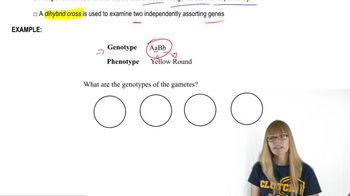
Gamete Genetics and Independent Assortment

Probability and Statistical Testing

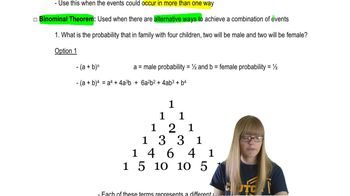
Probability in genetics quantifies the likelihood of observing certain phenotypic ratios by chance. Statistical tests, like the chi-square test, compare observed data to expected ratios to determine if deviations are due to random variation or suggest other factors. A high p-value indicates deviations likely arise from chance.
Recommended video:

Pedigree Analysis

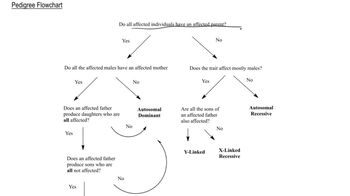
Pedigree analysis traces inheritance patterns across generations to identify genetic traits and their modes of transmission. It helps detect whether deviations from expected ratios are consistent within families or populations, indicating possible independent factors like linkage, mutation, or environmental effects.
Recommended video:
Guided course
01:59
Pedigree Flowchart