In numerous population studies of spontaneous mutation, two observations are made consistently: (1) Most mutations are recessive, and (2) forward mutation is more frequent than reversion. What do you think are the likely explanations for these two observations?
Table of contents
- 1. Introduction to Genetics51m
- 2. Mendel's Laws of Inheritance3h 37m
- 3. Extensions to Mendelian Inheritance2h 41m
- 4. Genetic Mapping and Linkage2h 28m
- 5. Genetics of Bacteria and Viruses1h 21m
- 6. Chromosomal Variation1h 48m
- 7. DNA and Chromosome Structure56m
- 8. DNA Replication1h 10m
- 9. Mitosis and Meiosis1h 34m
- 10. Transcription1h 0m
- 11. Translation58m
- 12. Gene Regulation in Prokaryotes1h 19m
- 13. Gene Regulation in Eukaryotes44m
- 14. Genetic Control of Development44m
- 15. Genomes and Genomics1h 50m
- 16. Transposable Elements47m
- 17. Mutation, Repair, and Recombination1h 6m
- 18. Molecular Genetic Tools19m
- 19. Cancer Genetics29m
- 20. Quantitative Genetics1h 26m
- 21. Population Genetics50m
- 22. Evolutionary Genetics29m
17. Mutation, Repair, and Recombination
Types of Mutations
Problem 11
Textbook Question
Why are frameshift mutations likely to be more detrimental than point mutations, in which a single pyrimidine or purine has been substituted?
Verified step by step guidance1
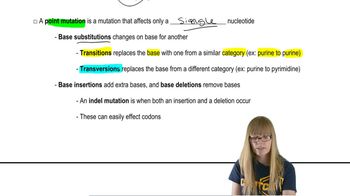
Understand the nature of point mutations: these involve the substitution of a single nucleotide base (a purine or pyrimidine) with another, which may or may not change the amino acid sequence due to the redundancy of the genetic code.
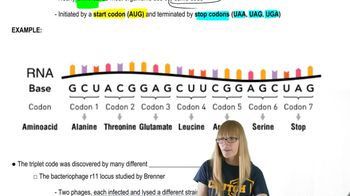
Recognize that frameshift mutations occur when nucleotides are inserted or deleted in numbers not divisible by three, causing a shift in the reading frame of the mRNA during translation.
Analyze how the reading frame shift alters the grouping of codons downstream of the mutation, potentially changing every amino acid encoded after the mutation site.
Consider the consequences of this shift: it often leads to the production of a completely different and usually nonfunctional protein, or introduces premature stop codons that truncate the protein.
Compare this to point mutations, which may only affect a single amino acid or sometimes have no effect at all (silent mutations), explaining why frameshift mutations are generally more detrimental.
Verified video answer for a similar problem:This video solution was recommended by our tutors as helpful for the problem above
Video duration:
51sPlay a video:
Was this helpful?
Key Concepts
Here are the essential concepts you must grasp in order to answer the question correctly.
Frameshift Mutations
Frameshift mutations occur when nucleotides are inserted or deleted from the DNA sequence, altering the reading frame of the gene. This shift changes every codon downstream, often resulting in a completely different and nonfunctional protein. Because the entire amino acid sequence is affected, frameshift mutations tend to have severe consequences.
Recommended video:
Guided course
Point Mutations
Point Mutations
Point mutations involve the substitution of a single nucleotide base, such as replacing one purine or pyrimidine with another. These mutations may cause a silent, missense, or nonsense change, often affecting only one amino acid or sometimes none, making their impact generally less severe than frameshift mutations.
Recommended video:
Guided course
Point Mutations
Genetic Code and Reading Frame
The genetic code is read in triplets called codons, each coding for a specific amino acid. Maintaining the correct reading frame is crucial for producing functional proteins. Frameshift mutations disrupt this frame, while point mutations usually do not, explaining why frameshifts are more detrimental.
Recommended video:
Guided course
The Genetic Code
Related Videos
Related Practice
Textbook Question
490
views