In humans, which region on the Y chromosome determines maleness?
Table of contents
- 1. Introduction to Genetics51m
- 2. Mendel's Laws of Inheritance3h 37m
- 3. Extensions to Mendelian Inheritance2h 41m
- 4. Genetic Mapping and Linkage2h 28m
- 5. Genetics of Bacteria and Viruses1h 21m
- 6. Chromosomal Variation1h 48m
- 7. DNA and Chromosome Structure56m
- 8. DNA Replication1h 10m
- 9. Mitosis and Meiosis1h 34m
- 10. Transcription1h 0m
- 11. Translation58m
- 12. Gene Regulation in Prokaryotes1h 19m
- 13. Gene Regulation in Eukaryotes44m
- 14. Genetic Control of Development44m
- 15. Genomes and Genomics1h 50m
- 16. Transposable Elements47m
- 17. Mutation, Repair, and Recombination1h 6m
- 18. Molecular Genetic Tools19m
- 19. Cancer Genetics29m
- 20. Quantitative Genetics1h 26m
- 21. Population Genetics50m
- 22. Evolutionary Genetics29m
3. Extensions to Mendelian Inheritance
Sex Chromosome
Problem 1b
Textbook Question
How do we know that in humans the X chromosomes play no role in human sex determination, while the Y chromosome causes maleness and its absence causes femaleness?
Verified step by step guidance1
Understand the biological context: In humans, sex determination is primarily controlled by the presence or absence of the Y chromosome, not by the number of X chromosomes. This is a key concept to keep in mind as you analyze the evidence.
Examine experimental evidence from individuals with different sex chromosome compositions, such as Turner syndrome (XO), Klinefelter syndrome (XXY), and typical male (XY) and female (XX) karyotypes. Notice how the presence of the Y chromosome correlates with male development regardless of the number of X chromosomes.
Consider the role of the SRY gene located on the Y chromosome, which is known to trigger male sex determination. The presence of SRY leads to the development of testes and male characteristics, while its absence results in female development.
Review studies involving sex-reversed individuals or cases where the SRY gene is translocated to an X chromosome, causing XX individuals to develop as males. This demonstrates that the Y chromosome, specifically the SRY gene, is the critical factor for maleness.
Summarize the reasoning: Since individuals with one or two X chromosomes develop as females in the absence of the Y chromosome, and the presence of the Y chromosome (with SRY) leads to male development, it shows that the X chromosome does not determine sex, but the Y chromosome does.
Verified video answer for a similar problem:This video solution was recommended by our tutors as helpful for the problem above
Video duration:
1mPlay a video:
Was this helpful?
Key Concepts
Here are the essential concepts you must grasp in order to answer the question correctly.
Sex Chromosomes and Their Role in Sex Determination
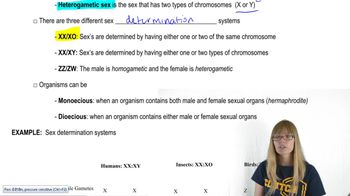
In humans, sex is determined by the presence or absence of specific sex chromosomes: X and Y. Females typically have two X chromosomes (XX), while males have one X and one Y chromosome (XY). The Y chromosome carries genes that trigger male development, making it the key determinant of maleness.
Recommended video:
Guided course
Sex Determination
Experimental Evidence from Chromosomal Abnormalities and Studies
Studies of individuals with atypical sex chromosome compositions, such as Turner syndrome (XO) and Klinefelter syndrome (XXY), reveal that the presence of the Y chromosome correlates with male traits. These observations demonstrate that the Y chromosome, not the number of X chromosomes, directs male development.
Recommended video:
Guided course
Genetics of Development
The SRY Gene and Its Function in Male Sex Determination
The SRY gene, located on the Y chromosome, encodes a protein that initiates the development of testes, leading to male differentiation. Its presence causes maleness, while its absence results in female development, confirming the Y chromosome’s pivotal role in sex determination.
Recommended video:
Guided course
Sex Determination
Related Videos
Related Practice
Multiple Choice
959
views
1
rank