Pearson+ LogoPearson+ Logo
Ch. 12 - DNA Organization in Chromosomes
Klug - Concepts of Genetics  12th Edition
Klug12th EditionConcepts of Genetics ISBN: 9780135564776Not the one you use?Change textbook
Chapter 12, Problem 16

Contrast the structure of SINE and LINE DNA sequences. Why are LINEs referred to as retrotransposons?

Verified step by step guidance
1
Begin by defining SINEs (Short Interspersed Nuclear Elements) and LINEs (Long Interspersed Nuclear Elements) as two types of transposable elements found in the genome, emphasizing their role in genome structure and evolution.
Explain the structural differences: SINEs are short sequences, typically around 100-300 base pairs, and do not encode proteins, whereas LINEs are much longer, often several thousand base pairs, and contain open reading frames that encode proteins necessary for their own mobilization.
Describe how LINEs have the machinery (such as reverse transcriptase and endonuclease) that allows them to copy and insert themselves into new locations in the genome, which is a key feature of retrotransposons.
Clarify that SINEs lack this machinery and rely on the proteins produced by LINEs to transpose, making them non-autonomous elements.
Conclude by explaining that LINEs are called retrotransposons because they transpose through an RNA intermediate that is reverse transcribed back into DNA before insertion, a process similar to retroviral replication.

Verified video answer for a similar problem:

This video solution was recommended by our tutors as helpful for the problem above.
Video duration:
1m
Was this helpful?

Key Concepts

Here are the essential concepts you must grasp in order to answer the question correctly.

Structure of SINEs (Short Interspersed Nuclear Elements)

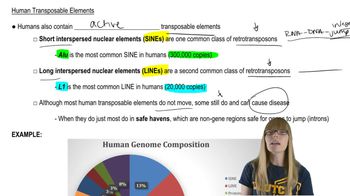
SINEs are short DNA sequences, typically 100-300 base pairs long, that do not encode proteins. They rely on other elements for their mobility and are derived from small RNA genes like tRNA. SINEs are non-autonomous, meaning they cannot transpose by themselves.
Recommended video:
Guided course
05:30
Human Transposable Elements

Structure of LINEs (Long Interspersed Nuclear Elements)

LINEs are longer DNA sequences, usually 6,000 base pairs, that encode proteins necessary for their own retrotransposition, such as reverse transcriptase. They are autonomous elements capable of copying and inserting themselves into new genomic locations.
Recommended video:
Guided course
05:30
Human Transposable Elements

Retrotransposons and Their Mechanism

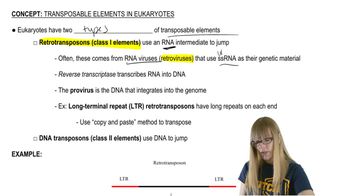
Retrotransposons are genetic elements that move within the genome via an RNA intermediate, which is reverse-transcribed back into DNA before insertion. LINEs are called retrotransposons because they encode enzymes enabling this copy-and-paste mechanism, unlike SINEs which depend on LINE machinery.
Recommended video:
Guided course
03:14
Eukaryotic Transposable Elements
Related Practice
Textbook Question

Assume that a viral DNA molecule is a 50-µm-long circular strand with a uniform 20-Å diameter. If this molecule is contained in a viral head that is a 0.08-µm-diameter sphere, will the DNA molecule fit into the viral head, assuming complete flexibility of the molecule? Justify your answer mathematically.

472
views
Textbook Question

How many base pairs are in a molecule of phage T2 DNA 52-µm long?

836
views
Textbook Question

Examples of histone modifications are acetylation (by histone acetyltransferase, or HAT), which is often linked to gene activation, and deacetylation (by histone deacetylases, or HDACs), which often leads to gene silencing typical of heterochromatin. Such heterochromatinization is initiated from a nucleation site and spreads bidirectionally until encountering boundaries that delimit the silenced areas. In the brief discussion of position effect, where repositioning of the w⁺ allele in Drosophila by translocation or inversion near heterochromatin produces intermittent w⁺ activity. In the heterozygous state (w⁺/w) a variegated eye is produced, with white and red patches. How might one explain position-effect variegation in terms of histone acetylation and/or deacetylation?

933
views
Textbook Question

Variable number tandem repeats (VNTRs) are repeating DNA sequences of about 15–100 bp in length, found both within and between genes. Why are they commonly used in forensics?

1050
views
Textbook Question

It has been shown that infectious agents such as viruses often exert a dramatic effect on their host cell's genome architecture. In many cases, viruses induce methylation of host DNA sequences in order to enhance their infectivity. What specific host gene functions would you consider as strong candidates for such methylation by infecting viruses?

569
views
Textbook Question

Cancer can be defined as an abnormal proliferation of cells that defy the normal regulatory controls observed by normal cells. Recently, histone deacetylation therapies have been attempted in the treatment of certain cancers [reviewed by Delcuve et al. (2009)]. Specifically, the FDA has approved histone deacetylation (HDAC) inhibitors for the treatment of cutaneous T-cell lymphoma. Explain why histone acetylation might be associated with cancer and what the rationale is for the use of HDAC inhibitors in the treatment of certain forms of cancer.

529
views